
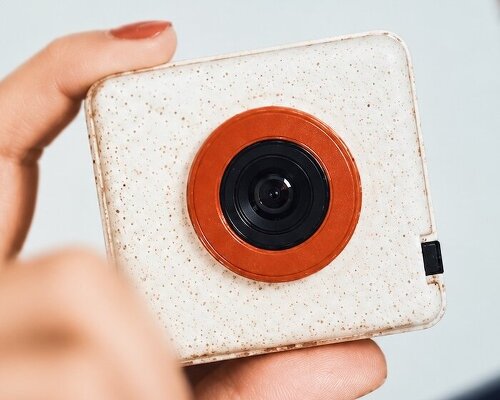
Sree Krishna Pillarisetti's Soft-pixel camera wants you to think about what you're really throwing away, and the answer isn't what Fujifilm taught you forty years ago. This is a digital camera with a compostable shell made from mycelium, hemp, and PHA bioplastic, a material that can break down in your home compost bin, unlike the PLA it replaces, which needs an industrial facility to go anywhere. We've seen Volvo's electric EX60 borrows leaves for its seats and a forest for its soul and we've watched this camera decomposes before your photos ever do, but Pillarisetti's project earns its European Product Design Award not just for swapping one polymer for another. It earns it for asking a sharper question: why does the entire device have to be the disposable part?
The disposable camera playbook has always treated the whole thing as a single-use object, plastic lens, cardboard body, chemical guts, all of it destined for a landfill the moment you drop the roll at the pharmacy. Soft-pixel borrows the form factor but flips the logic. The mycelium-and-hemp enclosure is the part that goes away. The electronics, the screen, the buttons, the circuit board held by four visible screws, are meant to stay. Pillarisetti's design literally shows you the screws, with a precision driver positioned over one, as if to say: open this. Replace the shell. Keep the camera. The photos live on a microSD card, not in a cloud subscription you'll forget to cancel. The only thing you compost is the packaging.
That is a genuinely weird and specific distinction, and it matters because most eco-design still treats electronics as monolithic objects you recycle whole. Soft-pixel says no: separate the durable from the disposable at the material level. The mycelium casing is grown, not molded, a biological process that produces a lightweight, impact-absorbing shell with the texture of a granola bar. The PHA bioplastic gives it a translucent outer layer that reveals the fibrous interior, so the thing looks organic because it partly is. But the real detail, the razor clam in the spec sheet, is that this won a Top Design award in digital cameras alongside its eco-design prize. That means a jury looked at the screen, the four directional buttons, the "Cheese!" label on the shutter, and said: this is a functional camera, not just a concept sculpture.
The open question, and the one we're watching, is whether anyone will build it. Pillarisetti's Soft-pixel is a project, not a product, it has awards, not a production timeline. The shift from PLA to PHA is significant for home composting, but PHA at scale is still expensive and fiddly. The screws say the designer wants you inside the device, but there's no mention of replacement shells for sale or a service that takes the old mycelium back. This is an invitation, not a guarantee. What matters is that the invitation exists at all, and that it comes with a specific material claim you can actually test: compost the shell, keep the electronics, store your photos locally. That's a concrete enough proposition to hold against any crowdfunding campaign that tries it later. We'll be watching for the one that does.