
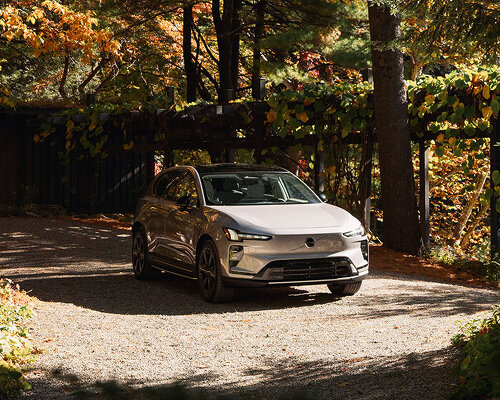
Volvo took the EX60 to Russel Wright's woodland home at Manitoga to show off its new electric SUV, and honestly, they should have just let the house do the talking. The car is good, 503 horsepower, 330 miles of range, a 0.26 drag coefficient, but the real story here is how desperately Volvo wants you to forget you're sitting inside a sealed metal box. The EX60 projects leaves onto its rear seats with a Forest Light ambient lighting system, and it offers a wool-blend upholstery that breathes better than leather. That's nice. But it's also a little sad, isn't it? We've reached a point where a car company has to simulate the outdoors because the actual outdoors is on the other side of the glass. It reminds us of This camera decomposes before your photos ever do, a mycelium disposable that rots before you finish the roll, both products that gesture at nature without quite touching it.
The wool upholstery is the most interesting thing in the cabin, and Sara Erichsen Susnjar, Volvo's Senior Color & Material Design Manager, was honest about the trade-off. Wool is braver than synthetic blends, she said, and it actually works, it regulates temperature, it stays comfortable in summer heat, and it doesn't trap sweat the way leather does. But it costs more, and customers expect a certain feel when they pay luxury-car money. That's a real tension, and Volvo deserves credit for pushing it. Meanwhile, the Forest Light system projects leaf patterns onto the rear seats, an effect we only saw partially because the presentation happened during daylight. That's the kind of detail that sounds lovely in a press release and feels gimmicky when you're stuck in traffic. Compare that to Wright's actual house, where he embedded pine needles into plaster walls and pressed butterfly wings into translucent screens. He didn't project nature, he physically stuffed it into the walls. This house split in half to make room for a rooftop garden does something similar, carving out literal space for greenery instead of just suggesting it. Volvo's approach is clever, but it's a projection, not a presence.
The EX60 is a solid electric SUV built on a dedicated platform, and the SPA3 architecture with cell-to-body battery integration is genuinely impressive engineering. The 16-minute charge time from 10 to 80 percent, under optimal conditions, is the kind of number that makes you stop scrolling. But the cabin feels like a compromise between wanting to be natural and needing to be digital. The 15-inch curved OLED display with Google Gemini sits right there, glowing, demanding attention, while the wool upholstery whispers that maybe you should look away from the screen. Wright's Manitoga handled this better: he used massive glass walls to bring the forest into every room, so the nature was always there, unavoidable. Volvo has to project leaves onto a seat because the windows are too small and the screens are too bright. It's a beautiful gesture, but it's a gesture.
The concrete takeaway is this: Volvo is betting that you will pay a premium for wool seats and leaf projections, and they're doing it while the EX60 still faces real questions about pricing, availability, and whether the Forest Light effect holds up after six months of daily use. The house at Manitoga was built over decades, with materials gathered from the land it sits on. The EX60 was built in a factory. That's not a sin, but it means the forest in the car will always be a simulation, and simulations get old. The wool upholstery won't. That's the detail to watch.