
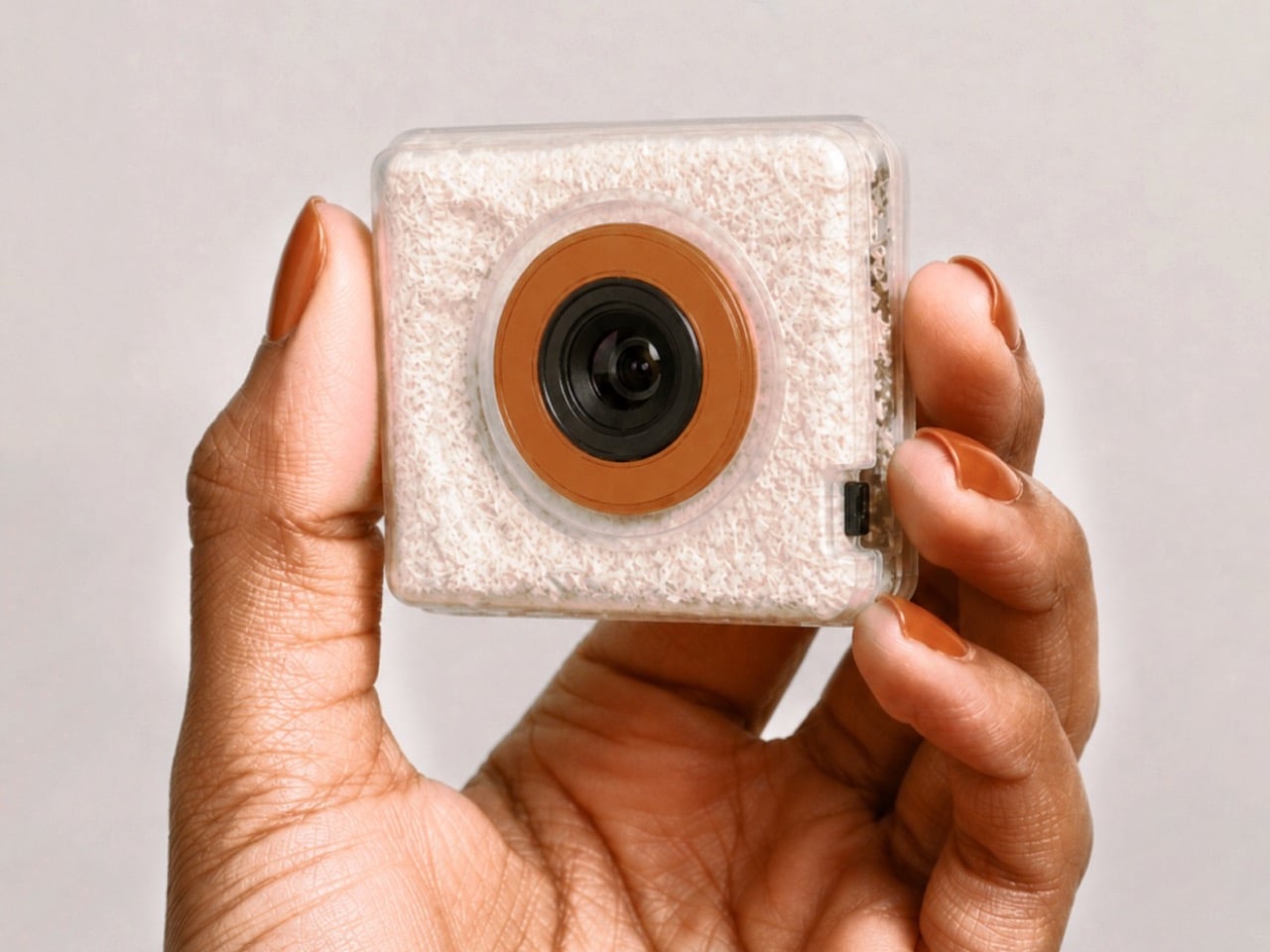
Forty years of plastic disposable cameras, and the most honest thing about the Soft-pixel is that it refuses to pretend the shell matters most. Sree Krishna Pillarisetti's concept wraps a digital camera in mycelium, hemp, and PHA bioplastic, then dares you to wonder which part of the disposable-camera ritual actually needs to be thrown away. It is a beautifully uncomfortable question, and it lands harder than any eco-label ever could. We have seen the disposable-camera idea revived before, This disposable camera clone develops your photos in a single day tried to recreate the analog wait, and Even Realities snuck the smart glasses into the tortoiseshell proved that beautiful enclosures can make you want the thing underneath. Soft-pixel goes further: it makes the enclosure the question, not the answer.
The camera keeps a screen, four directional buttons, and a shutter that literally says "Cheese!" It stores photos on a microSD card instead of shipping them to a data center. That local-storage choice is the quiet knife in this design. The International Energy Agency estimated that data centers consumed about 415 terawatt-hours of electricity in 2024, roughly 1.5% of global electricity consumption, with a base-case projection of 945 TWh by 2030. Soft-pixel does not pretend to solve that problem alone, those totals cover far more than photo storage, but it does something more pointed: it makes the cloud feel like a choice rather than a default. The camera is a concept, with no price or release date listed in its award entry, and we should say that plainly. But the idea already works as a provocation. Keep the electronics. Keep the photos. Give the shell a different end of life.
That shell is the part that demands scrutiny. Pillarisetti's process combines biological growth with heat-press fabrication to produce what the entry calls a lightweight, impact-absorbing enclosure. The shift from PLA to PHA matters because PLA generally needs industrial composting to break down, while some PHAs can biodegrade in home compost, but behavior depends on formulation and conditions. Putting PHA in a camera shell does not automatically make the finished casing ready for your garden pot. We need to know how the finished casing actually composts, at what rate, and under what conditions. The visible screws in the design are the real tell: someone expects you to open this thing, which is a spicy move for a camera borrowing the disposable playbook. That screwdriver-ready circuit board suggests a different relationship with the object, one where the shell degrades and the guts keep going.
The obvious comparison is Camp Snap, the screen-free digital camera that makes you wait to review photos on another device. Soft-pixel keeps the screen and aims at a different enemy. It is not fighting film waste or battery anxiety. It is fighting the assumption that your photos belong to a server farm. The translucent outer layer shows off the fibrous interior, making the camera look a bit like a granola bar that takes pictures, and the European Product Design Award named it Best Eco-Design for 2026 alongside a Top Design win in digital cameras. That is validation for a concept that still has open questions: no sensor, resolution, battery capacity, or storage capacity listed. The detail to watch is not the mycelium. It is the PHA. If the shell actually composts in a home bin, and if the electronics can be swapped into a new one, this stops being a concept and starts being a template for how we stop throwing away the part that works.