
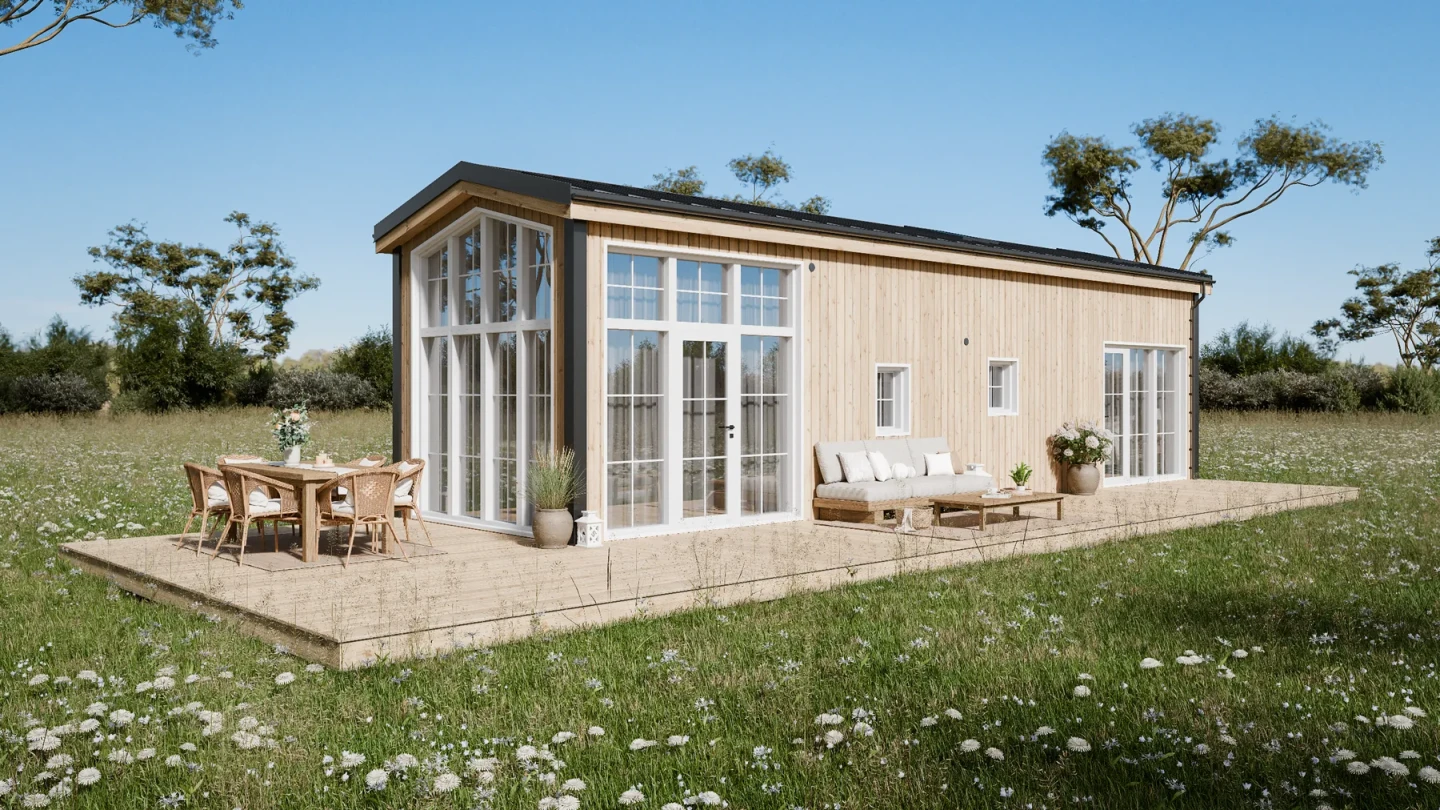
This cottage-sized tiny house swapped wheels for windows, and honestly? Good. The tiny house movement has spent years pretending everyone secretly wants to be a digital nomad, and this thing finally calls the bluff. By ditching the trailer chassis and all the compromises that come with it, the narrow hallways, the lofted bed you can only access by shimmying up a ladder, the ceiling that makes you feel like a giant in a dollhouse, this design frees itself to focus on what actually matters: light, space, and the feeling of a real home. It's not the one for The Helena tiny house refuses to fold up small and that's exactly why it works, but it's for the person who wants a small footprint without the constant reminder that their house is also a truck.
We should celebrate this. The obsession with "road-ready" has held tiny houses back for years. You end up with a vehicle that's an awkward home, or a home that's an awkward vehicle. This one chooses to be a house first. Its XL dimensions, larger than the typical towable, allow for a proper interior, one where natural light pours in through windows that aren't squeezed between wheel wells. It reads less like a camper and more like a small cottage you might find tucked into a forest clearing. That's a meaningful shift. It acknowledges that most people who buy tiny houses don't actually move them every weekend. They park them on a piece of land and stay put. This design serves that reality, not the fantasy of perpetual motion. Compare it to The Tinde's porch roof steals the show before you step inside, which makes its first impression outdoors, or the tiny house with a home office and a netted hangout zone, which packs a surprising amount of function into 28 feet. Each of those houses makes a specific trade-off. This one trades mobility for livability, and that trade is worth examining closely.
The practical takeaway here is blunt: if you are shopping for a tiny house, ask yourself honestly how often you plan to move it. If the answer is "maybe once, to get it delivered," then wheels are a liability, not a feature. You are paying for an axle, a hitch, and a set of tires that will sit in the grass and rot. You are accepting a narrower floor plan and a weight limit that constrains your insulation and finishes. This house sidesteps all of that. It sits on a foundation, or at least on skids, and it gets to be wider, brighter, and more structurally generous as a result. That is not a compromise. It is a correction.
The one open question, and it's a big one, is cost. A foundation-ready tiny house of this size, with this many windows and a proper cottage aesthetic, is not going to be cheap. The materials and labor that go into a real roof, real windows, and real insulation add up fast. The related articles don't give us a price on this one, and the builder's page doesn't either, which is the part that makes Spoot's ears twitch. A beautiful concept is one thing. A price tag that makes it attainable is another. Until we know what it actually costs to park this thing on a plot of land and hook it up, the most important spec is still missing.