
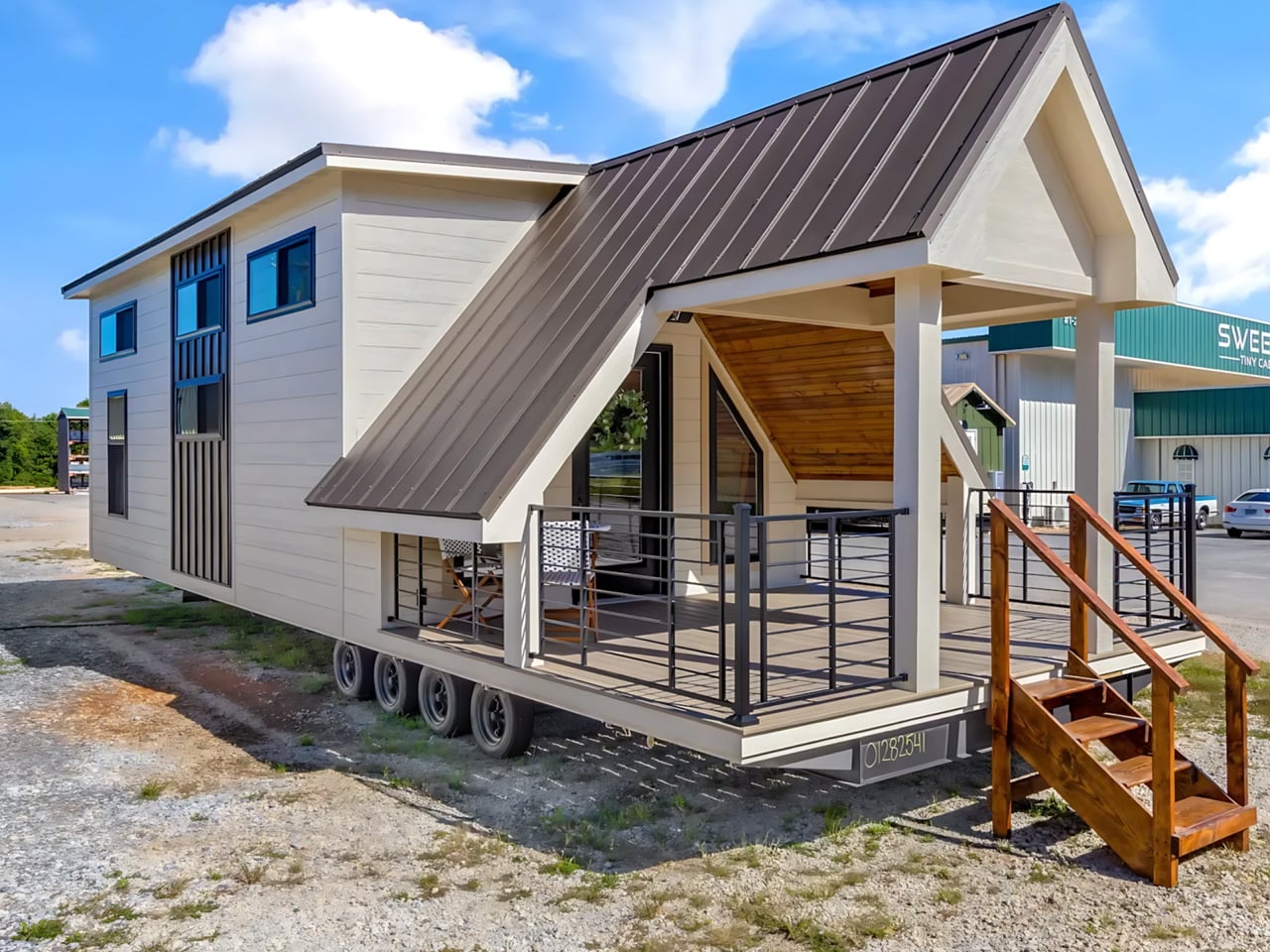
The Tinde's porch roof is the best part of the house, and it's a $15,000 upgrade. That's the razor clam in this spec sheet, the detail that changes everything about how you read the listing. Sweet-Haus Tiny Cabin Company has built a 48-foot park model that looks like a woodland cabin, with a steeply pitched A-frame porch that dominates the front elevation and gives the entrance a dramatic, sheltering presence. But that roof is optional. The base Tinde starts at $131,000 without it, and the photographed build that makes you want one costs $146,000. That's a meaningful gap, and it's the kind of thing Spoot circles back to while everyone else is already pinning the picture.
What the Tinde does well, with or without the dramatic roofline, is refuse to treat the porch as an afterthought. That covered outdoor space becomes the home's most distinctive room, a place to gather, spread out, and breathe before you ever touch the doorknob. It's a smart move in a 48-foot home where interior square footage is finite. Inside, the extra 14-foot width gives the living room enough room for a sofa, an armchair, and a built-in counter with stool seating, leaving the floor comparatively open. That matters because the living area also doubles as the circulation hub between the entrance and kitchen. Compare that to the approach in The Traveler folds out a bed so you never climb a ladder, which solves the spatial puzzle by folding a sofa into a ground-floor bed and eliminating the loft entirely. The Tinde keeps its loft as an option rather than a necessity, which is a more flexible but less space-efficient choice. Then there's Mini Domy's new A-frame squeezes home comforts into a very compact triangle, which goes all-in on the A-frame geometry for the entire structure. The Tinde uses the A-frame as a porch hat, a theatrical gesture that doesn't compromise the interior layout.
The bonus room is where buyers will make their most consequential decision. Sweet-Haus lists it as an open space with potential uses including bunks, laundry, an office, or storage. That's not a feature list; it's a prompt. In a home where the living area already handles dining, lounging, and circulation, that one small room becomes the pressure valve. Want to work from home without a laptop on the kitchen counter? That's the bonus room. Need to dry towels without draping them over the sofa? Bonus room. The company says the bedroom, loft, and bonus room can sleep up to six, but that's sleeping capacity, not six private bedrooms. The bunk arrangements are listed as upgrades, so the cost of hosting guests adds to the base price. Bathroom options include a tub-shower or a walk-in shower at no extra charge, which is a genuinely useful choice, a tub is a luxury in a tiny house, and not everyone wants to climb over one to shower.
The $15,000 porch roof asks a practical question: is the entrance worth more than the kitchen upgrade? Because that's the trade. The Tinde's appeal is clear, it devotes substantial space to gathering, indoors and out, but the base configuration is a different house than the one in the photographs. Buyers who want the woodland cabin curb appeal should budget accordingly. Everyone else should look at the bonus room and decide what they're actually going to put in it, because that's where the Tinde's flexibility becomes either a genuine asset or an unfinished question.