
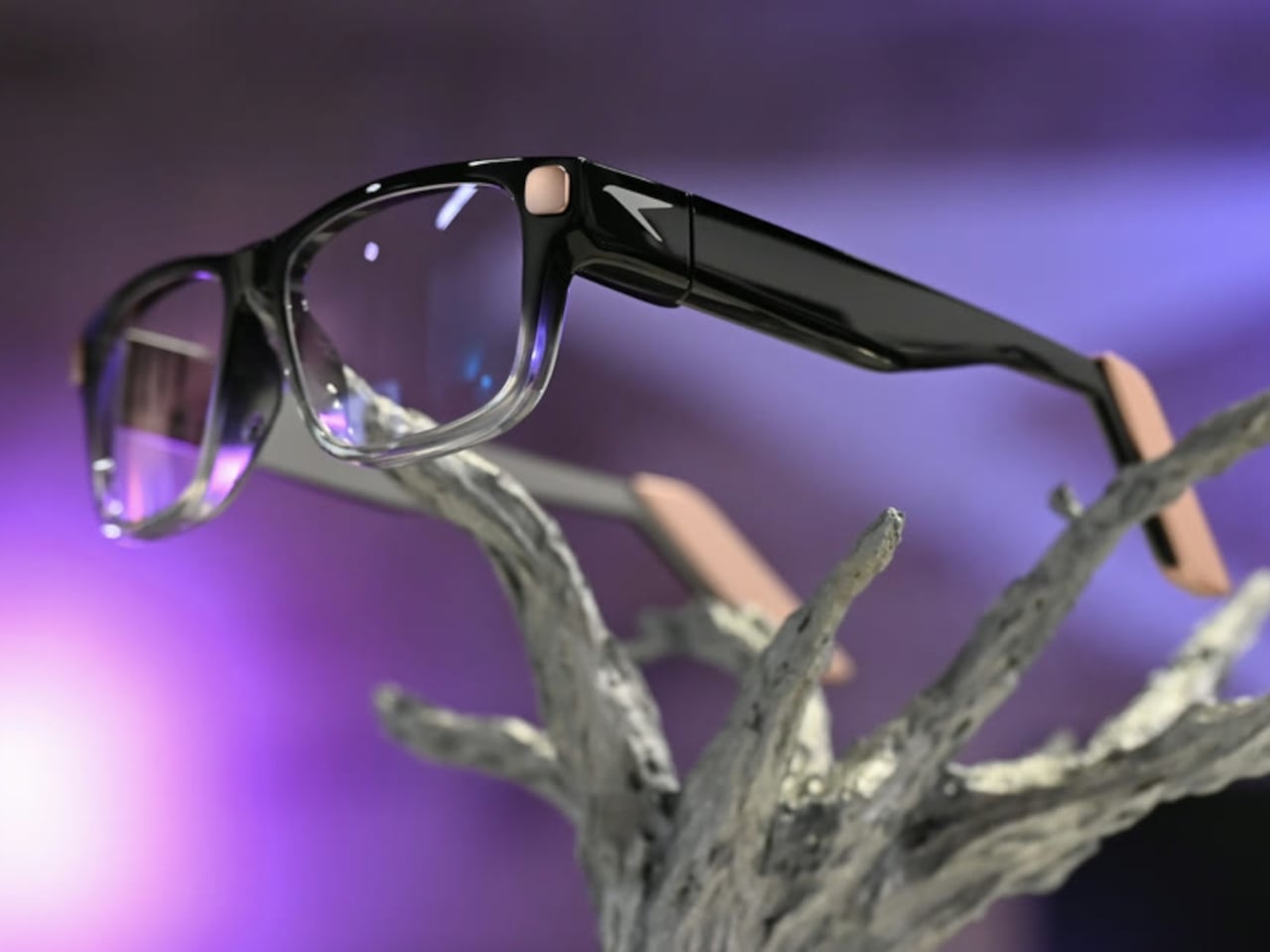
Raven Prism glasses are genuinely interesting, and they might also be a complete pain to wear all day. That tension is exactly why they deserve your attention, not because they promise to replace your phone, but because they refuse to pretend that a smart wearable can be invisible. Raven Resonance has built a Linux computer into a pair of glasses that looks like it contains a Linux computer. The temples are thick. The battery modules clip on and off. The display lives in the corner of your right eye, a full-color waveguide with a 30-degree diagonal field of view, positioned so you glance at it rather than through it. That is a weird, deliberate, and oddly honest design choice. Most smart glasses try to vanish. These announce themselves, then ask whether you can live with the trade-offs.
The practical pitch is flour-on-your-fingers cooking. A recipe in your peripheral vision, controlled by holding your gaze on a button, leaves both hands free. It is a narrow, specific use case, and Spoot respects a product that picks one. But narrow use cases have a way of colliding with the rest of your day. Looking away from your hands still requires choosing a sensible moment to pause, and the developer guidance admits that eye control demands large targets and uncrowded layouts. Distinguishing a deliberate selection from an ordinary glance is a hard problem, and Raven is asking developers to design around it rather than claiming to have solved it. That is more honest than most launch copy, but it also means the experience will depend heavily on apps that do not exist yet. Compare this to something like the Arrowmax puts a tiny camera in your screwdriver so it can ID the bit for you, which solves a single, clear problem with a single, clear hardware trick. Raven Prism is asking you to trust that a whole ecosystem of gaze-driven software will appear by the time your reservation ships in summer 2027.
Privacy gets a physical cover for the 13-megapixel camera and lights in the rims that signal when it is active. Speech recognition runs locally. Cloud sharing requires consent. These are good boundaries, clearly stated, and they matter more here than they do for most wearables because this thing stays on your face. The Amazon hid a camera in your speaker and stuffed Alexa in a frame approach, bury the sensor, hope you forget, is not an option when the sensor is mounted on your nose. Raven deserves credit for making the camera's operation physically gated. But these are design choices, not an independent security audit, and the difference matters when the device is running a full Linux stack with remote developer access.
The battery solution is the most pragmatic thing here. Raven Wings are removable modules that swap without shutting down your apps. Two pairs and a charging case are included, so you wear one set while the other charges. That makes the all-day ambition about exchanging batteries, not about a single pair lasting from morning to night. It is a workaround that acknowledges the physics of cramming a quad-core ARM processor with up to 4GB of memory into a frame, and it is more honest than promising twelve hours of runtime that never materializes. At $1,499 with supported prescription lenses, and with initial US shipments not arriving until January 2027 at the earliest, Prism asks for a lot of patience and a lot of money. The question is not whether the technology works, the waveguide display and eye tracking are real, and Raven OS is real. The question is whether you want to keep the screen, batteries, and computer on your face all day. That is a question only you can answer, and Raven has at least been honest enough to let you see exactly what you are agreeing to.