
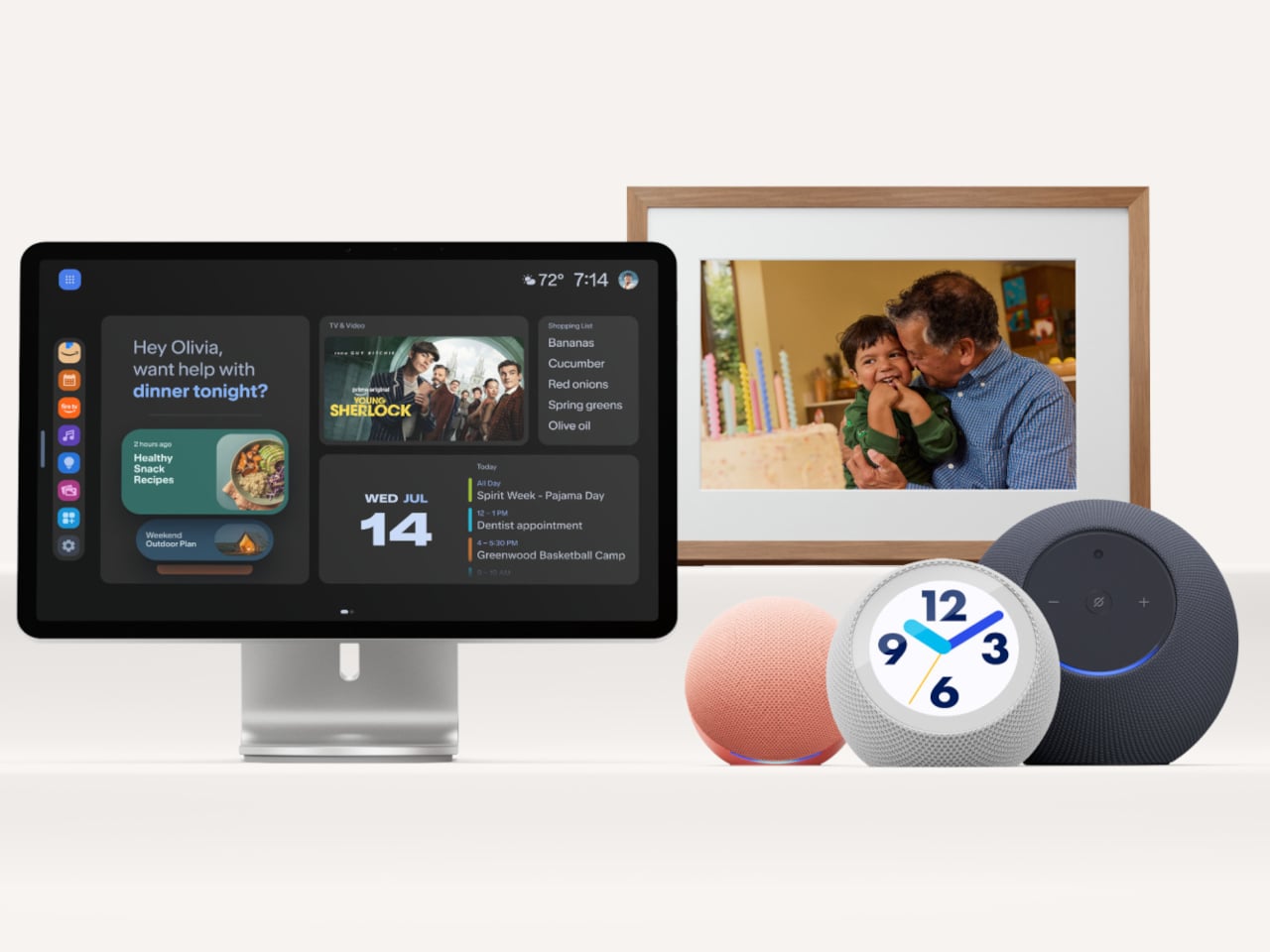
Amazon just announced a speaker that can see you and a picture frame that talks back, and I'm not sure which one unsettles me more. That's the editorial opinion, right there in the open: these are clever, well-designed objects that ask for a level of domestic intimacy most of us haven't thought through. The Echo Studio with Home Camera drops a lens into a fabric-covered speaker for $249.99, no physical shutter over the eye, just a button that disables mics and camera when you remember to press it. Meanwhile the Alexa Photo Frame wraps a 10-inch touchscreen in real birch or walnut, masquerading as a family heirloom while Alexa+ scrolls through your camera roll for pictures of your dog. It's the same kind of hiding-in-plain-sight trick we saw with This camera decomposes before your photos ever do, except that mycelium camera was honest about being temporary. Amazon's frame wants you to forget it's a screen at all.
The practical takeaway is this: if you buy the Echo Studio with Home Camera, you are putting a cloud-connected camera in your living room that has no physical cover. Amazon says you can hold up a board game and ask Alexa+ to explain the rules, or check on the dog through Live View. That's genuinely useful for about three minutes. The rest of the time that lens is pointed at your couch, your coffee table, your face after a long day. The button disables both microphones and camera, but a button is not a shutter. Compare that to the Echo Time, a $199.99 bedside clock with a 3.2-inch circular screen and no camera at all, a deliberate omission that feels like a breath of fresh air. It uses ultrasound for optional sleep sensing, which is its own can of sensors, but at least nobody is watching you sleep through a lens. Amazon's own lineup makes the tradeoffs visible: you can have the helpful eye or you can have the camera-free clock, but you cannot have both in the same room without deciding which room gets the watcher.
The Alexa Photo Frame is the more insidious device because it looks like decor. It starts at $199.99 in black or $229 for real wood, textured white matting around the display, and it pulls from Amazon Photos to show your family, pets, and vacations on voice command. Amazon says Alexa+ skips screenshots and receipts, which is nice until you remember that your camera roll is full of screenshots and receipts anyway. The frame's whole job is to make a surveillance-adjacent product feel like a gift from Grandma's attic. It echoes the same quiet creep we noticed with Amazon's Echo duo gets a smarter home and a bigger ear, where the speaker's job expanded without asking whether you wanted it to. Here the expansion is visual: the frame doesn't just play music or set timers, it looks at your life and curates it. That's a lot of trust to put in a device that costs $19.99 a month to unlock its best features.
The Echo Dot at $99.99 quietly does more than the headline grabbers. It adds Zigbee, Matter, and Thread support, turning a small fabric sphere into a smart home hub that extends eero networks. That's the kind of boring, useful upgrade that actually changes how your home works, no camera, no frame, just a hub that lives inside a speaker. The Echo Show 16 costs $499.99 and ships later this year, a massive kitchen screen with Fire TV built in and stands sold separately. But the question that sticks with me is the one Amazon's launch video skipped: who in your house is comfortable with a camera beside the sofa, and who is going to forget the button exists? Before you clear a shelf for the walnut frame or the fabric speaker with the new eye, decide which household routines actually need a camera and which are doing perfectly fine with a clock that just tells the time.