
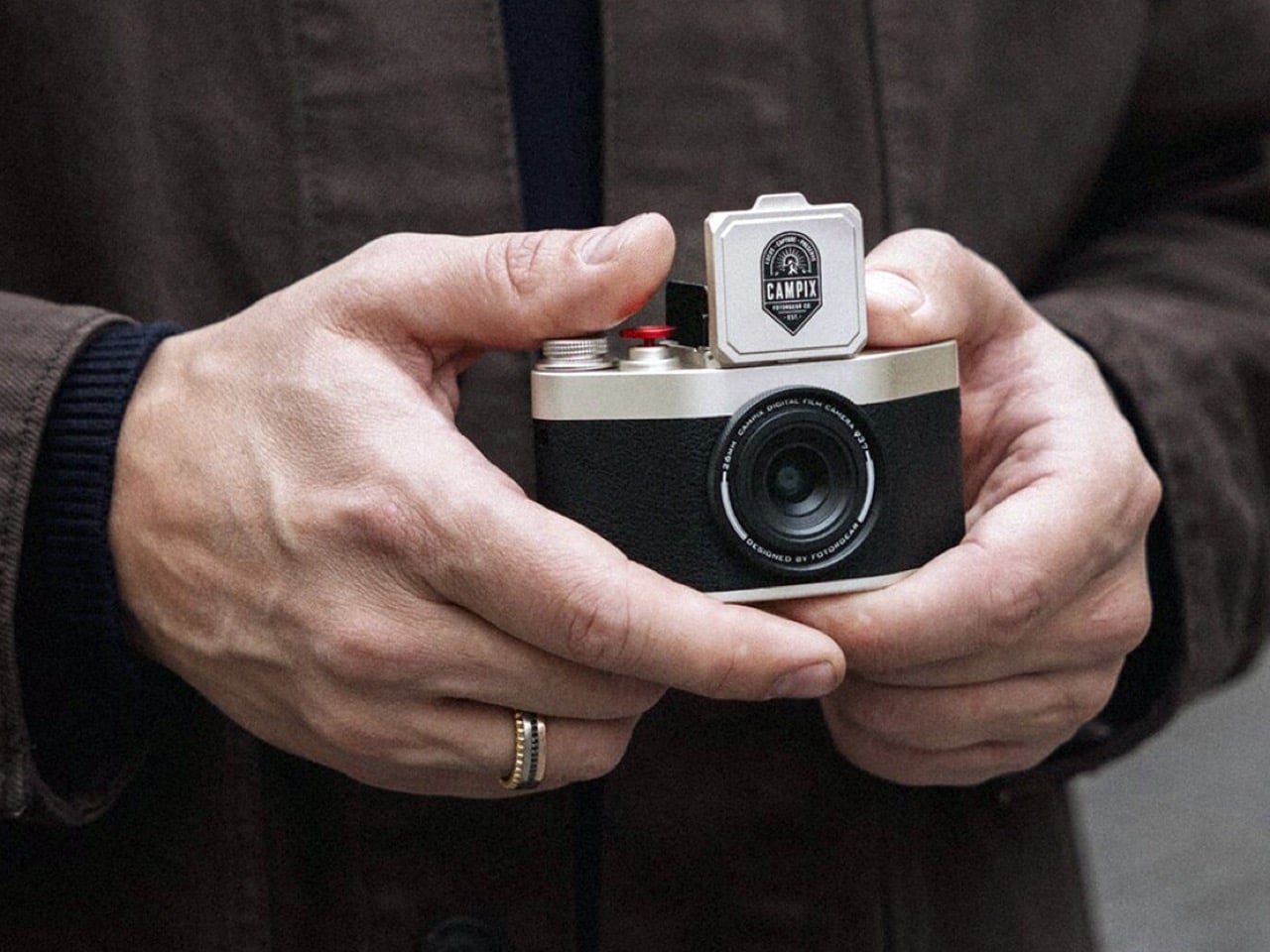
The Campix is not a camera for people who need good photos. It is a camera for people who need a reason to take them in the first place, and that is a much more interesting product to build. FotorGear spent years selling clip-on lenses and grips that turned an iPhone into a prop, winning a London Design Award for a kit that made the phone part feel like an afterthought. Now the company has finally cut out the middleman, and the result is a $209 digital camera with a 13MP Sony sensor, a waist-level viewfinder, and a mechanical dial you have to wind between frames. It is the kind of object that makes you wonder why nobody else thought of it, or at least why they charged eight hundred bucks for the privilege.
The waist-level finder changes how you behave. You look down into the hood instead of raising the camera to your eye, which means you bow toward the scene and the people in it stay relaxed because no lens is pointed at their face. That is a genuine design insight, and it is one that Fujifilm borrowed for the X half's film camera mode without committing to it fully. The Campix builds the whole experience around the constraint: no rear screen, no playback, a fixed-focus 26mm f/2.2 lens that asks you to zone focus and trust yourself. Each 36-frame digital roll locks you into one film recipe until you finish it, the same way loading Portra used to commit you to a look for the afternoon. It is an honest piece of design, and it costs about a quarter of what Fujifilm asks.
The sensor is the same Sony IMX258 you would find in a mid-range smartphone from half a decade ago, and the files will land closer to a good phone shot than to the X half's 1-inch output. That is the trade-off for the size and the price, and it is worth stating plainly. But the Campix also carries a T-mount that accepts the same fisheye, wide, portrait, macro, and anamorphic lenses FotorGear already sells for phones, which means anyone with a drawer full of those accessories just found them a second home. The anamorphic lens alone, with its squeezed widescreen frame and streaky flares, turns the waist-level perspective into something that feels like a prop from a Wong Kar-wai set. The macro and portrait lenses pull you in tighter, and the fixed focus on the body means you move your feet until the subject snaps in. It is a trade-off born from simplicity, and it suits a device designed to slow you down anyway.
The practical question is whether FotorGear can ship. Kickstarter pricing starts at $109 for the basic model, with worldwide delivery scheduled for January 2027, which is a long wait for a camera built around a sensor that was already old when the pandemic started. The HMD's $113 phone speaks a language the spec sheet forgot and the Fairphone 6 Plus drops to $552 and still wants you to fix it yourself both prove that people will pay for hardware built around a philosophy rather than a spec sheet, but those products shipped. The Campix is a concept rendered in polycarbonate and leather, and the margin between a clever idea and a camera you can actually hold is the difference between a footnote and a classic. The detail to watch is not the sensor or the price. It is whether the wind dial clicks the way you remember.