
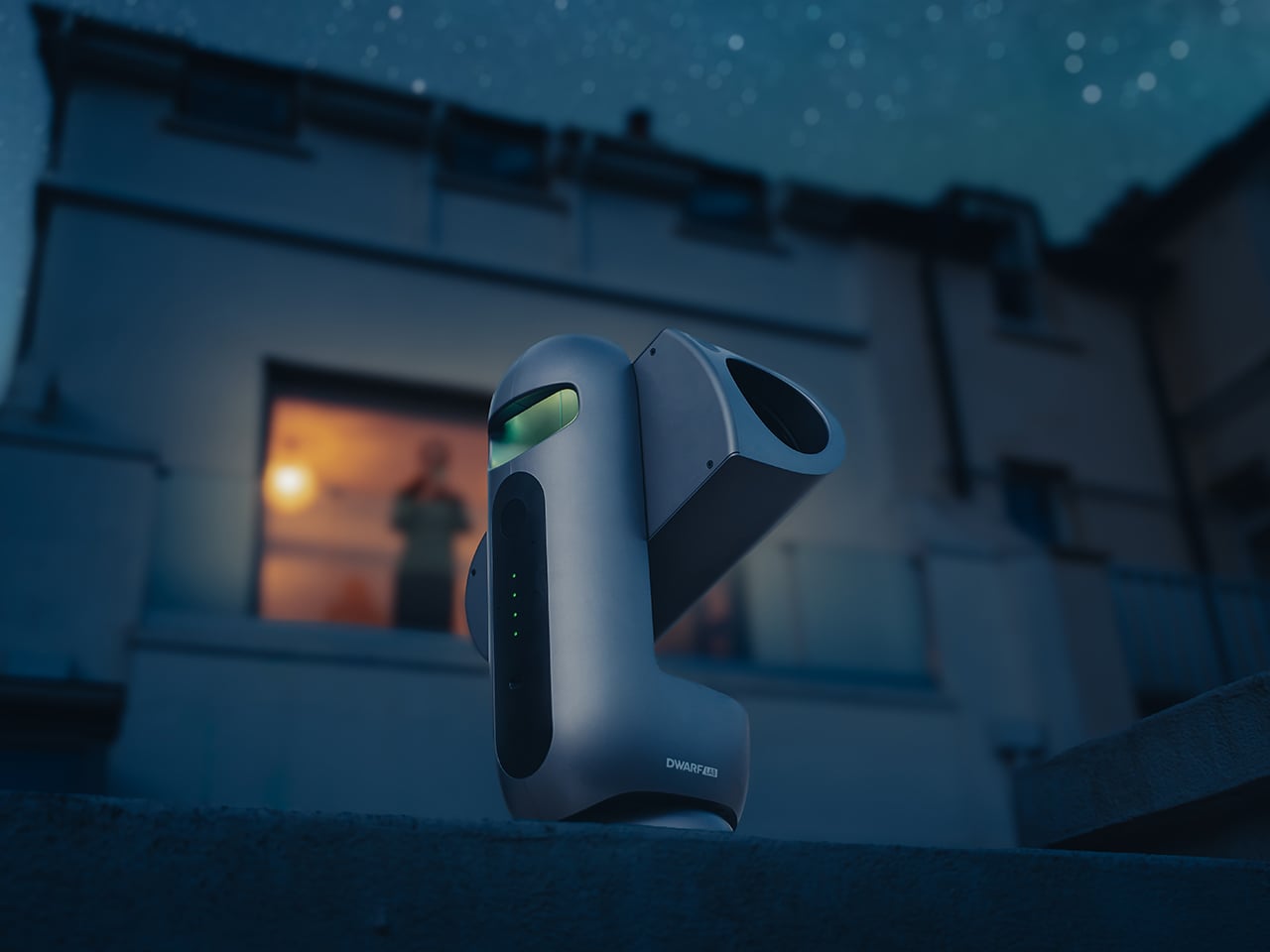
Astrophotography has been waiting for someone to build the telescope that does the boring part for you, and DWARFLAB finally did it. Draco is the smart telescope that wakes itself up, shoots the night while you sleep, and asks for almost nothing in return except a tap on your phone. This is the first serious deep-sky imager that treats polar alignment like a bug, not a feature, and that changes the calculus for anyone who has ever stood in a freezing field at 3 a.m. with a red flashlight between their teeth.
The clever fix is a sensor that physically rotates to cancel out the sky's spin, holding single exposures for up to 300 seconds on a simple alt-azimuth mount. Most smart telescopes top out around 60 seconds before field rotation turns stars into smears, so Draco jumps the category into territory that traditionally required an equatorial mount, a guide scope, a separate camera, and a nest of cables you spend an hour balancing in the cold. The whole system weighs 12.1 pounds and you carry it with one hand. It is, in spirit, the opposite of Kenko's pieni III has no screen and no idea what you're pointing at: perfect, where that camera celebrates the chaos of guessing where your frame lands, Draco eliminates every variable that requires a guess. One device wants you to surrender control; the other automates it so completely that the hardware runs the session while you sleep. Both are honest about what they are, and both are refreshing for it.
The 90mm aperture gives you roughly 3.2 times the light-collecting area of the 50mm scopes that dominate this category, and the folded f/3.8 optical system is fast enough that faint nebulae build up sooner. The SHO Edition automates Hubble Palette imaging, sulfur, hydrogen, and oxygen captured through narrowband filters and merged in the app with one tap, which usually costs a weekend and a laptop to pull off by hand. ZWO's Seestar S50 Pro costs $999 with half the aperture. Draco's Standard Edition is $1,399 and already sold out. The SHO Edition is $1,599 and shipping within three months. That price gap is smaller than the performance gap, and the performance gap is exactly where DWARFLAB has aimed.
The concrete takeaway is this: Draco makes the smart telescope category serious for people who already own traditional rigs. Early smart scopes won over beginners with short exposures and heavy stacking, so serious imagers kept their real gear. Draco's 300-second single frames and onboard guiding put it in the same conversation as an entry-level equatorial setup, but in a body that looks like a very expensive thermos and runs on a 10,000mAh battery. The open question is whether the app and the integrated computing can match the flexibility of a mini-PC and a filter wheel when you want to push beyond presets. DWARFLAB has folded the hardware into a product instead of exposing it as a system, which makes it easier to use and harder to hack. For the kind of person who has ever wondered why That electric superbike hides its battery in a honeycomb and it's brilliant, the one who reads the footnote before the marketing copy, the question is whether Draco's software is as clever as its hardware. That answer will arrive when the first units ship and someone schedules a target, goes to bed, and wakes up to find out whether the dragon actually caught the light.