
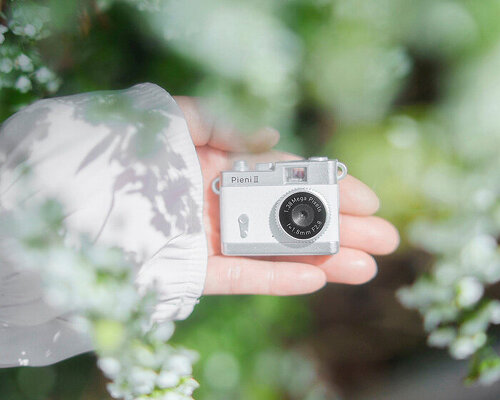
Kenko's Pieni III is the most liberating camera you can buy this year, precisely because it refuses to show you what it sees. That's not a missing feature; it's the whole point. While Rivian's Halloween update turns your EV into a ghost-hunting light show proves you can turn a pickup truck into a paranormal spectacle, and 24 shots, zero duplicates: $146 Await makes every frame feel like film brings back the discipline of a disposable roll, Kenko has done something weirder and arguably more radical: it has removed the very thing that makes a digital camera a digital camera. No screen. No viewfinder. No instant gratification. You point this 18-gram pendant at something, press a button, and the mystery begins.
The Pieni III is not a toy, though it looks like one. It is a deliberate constraint machine. Weighing less than a pair of AAA batteries and measuring just 53 millimeters across, it hangs around your neck in pastel pink Strawberry or pale blue Soda, and its silver top and circular lens mimic the proportions of a classic film camera. But inside is a 1/10-inch CMOS sensor with a laughable 0.32 megapixels of effective resolution. Still images are saved as 1440 x 960-pixel JPEGs through digital interpolation, meaning the files are bigger than the actual data, and they look it. Kenko's own sample photos show flowers reduced to fuzzy patches of vivid color, foliage softened into something approaching watercolor, and edges that look like they were drawn with a coarse brush. It is the aesthetic of early digital photography, but made deliberately, by hardware. You cannot filter your way here.
This is where Spoot gets genuinely excited, because the Pieni III asks a question the industry abandoned years ago: what if the camera didn't know what it was looking at? With two buttons handling power, shutter, and the switch between stills and video, and a tiny indicator light glowing red for photos or blue for video, the entire interaction is instinctual. You frame with your gut, not with a grid. You compose by feel, not by zooming in on the preview. The result is photographs that surprise you, because the subject drifted toward the edge of the frame or an unexpected detail crept into the shot. That is not a bug. That is the razor clam buried in the spec sheet that everyone else scrolled past. The magnetic back lets you stick it to a railing for hands-free video, and USB-C connectivity means you transfer the files to your phone later, but the real innovation is the omission. There is no instant review. There is no second take. There is only the shutter and the wait.
The practical consequence for our readers is straightforward: the Pieni III is not a replacement for your smartphone or your mirrorless camera. It is a companion for the moments when you want to stop optimizing and start guessing. It costs what it costs, and it ships when it ships, but the real question is whether you are willing to trade control for serendipity. The Pieni III captures video at 720 x 480 pixels and 30 frames per second, and stores everything on a microSDHC card you buy separately, so the technical ceiling is low. But that ceiling is the feature. In a world where every device screams for your attention with a screen, Kenko has made one that whispers. The question is whether you are listening closely enough to hear the shutter.