
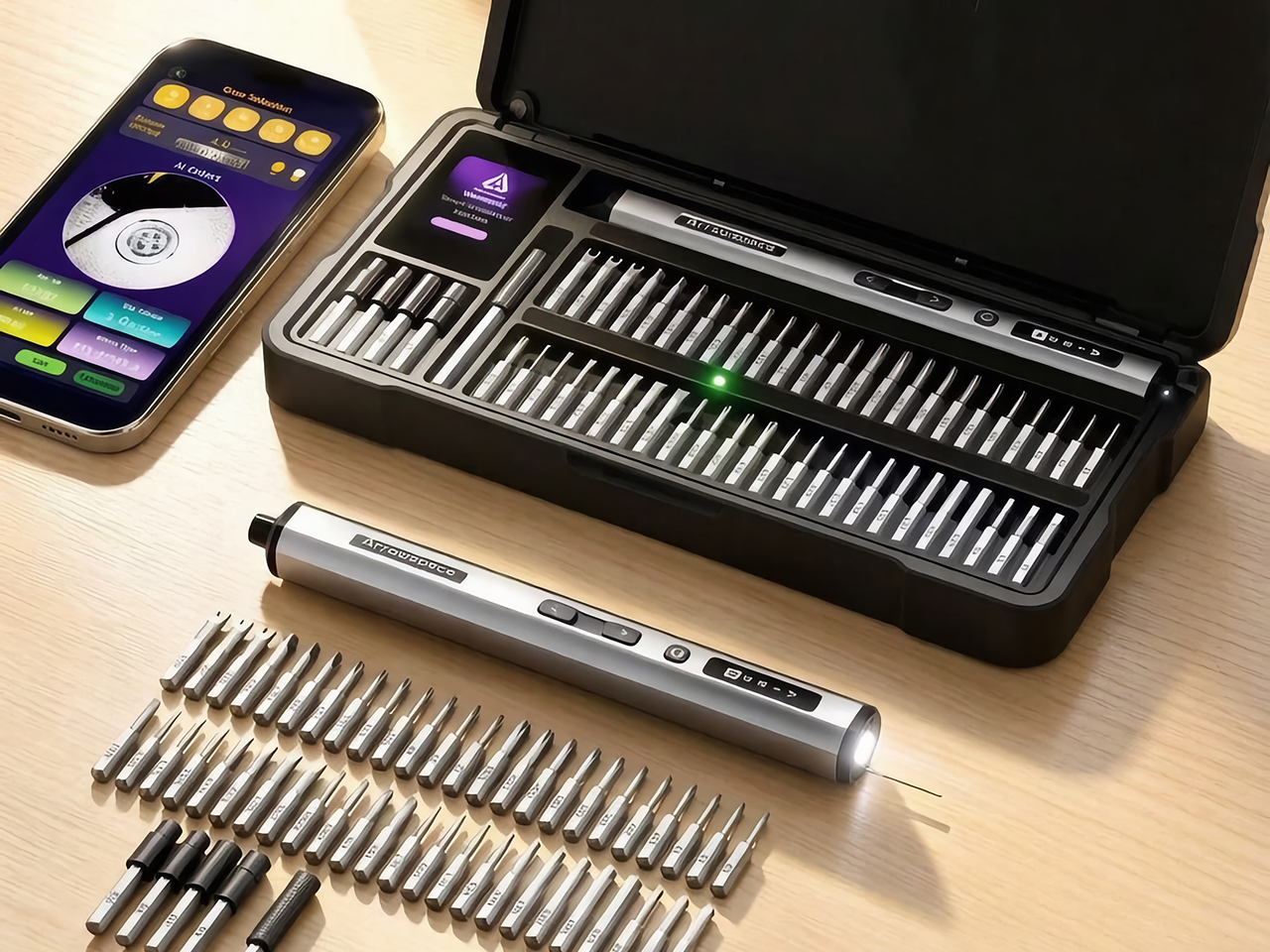
The Arrowspace S1 doesn't just want to help you pick the right screwdriver bit, it wants to eliminate the entire guessing game that turns a five-minute repair into a fifteen-minute hunt through a drawer of identical-looking metal tips. And honestly? That's the kind of specific, almost absurdly thoughtful problem-solving that makes us sit up straighter. This isn't a screwdriver that merely spins; it's a screwdriver that *looks* first, using a rear-mounted camera and a contact probe to scan the fastener, identify its profile in a local phone app, and then light up the correct slot in its 52-bit case. It feels like the logical offspring of a precision tool and a museum audio guide, and it arrives at a moment when we've already seen other gadgets try to solve adjacent problems, like the Nitecore hides a razor blade inside a flashlight and calls it a multitool, which stuffs an unexpected function into a familiar form, or the HOA A1 Camera Lets You Look at People, Not at a Screen, which rethinks where the interface lives. The S1 does something similar: it moves the identification step from your squinting eyes to a dedicated sensor, then points you back to the physical world.
What makes this feel less like a gimmick and more like a genuine quality-of-life upgrade is how it handles the friction points. The camera sits at the rear, opposite the driving end, and you press a contact probe against the screw to set a consistent focal distance before scanning. That's a wonderfully tactile solution, a physical anchor for a digital process. The recognition runs locally on your phone, so you're not waiting on a cloud server or worrying about privacy, and it handles twelve common screw-head profiles. Once identified, the case's 2-inch TFT display shows the info, and an LED lights up the correct bit slot. You still have to pick the bit and fit it yourself, but the detective work is gone. That's the razor clam in the spec sheet: the case becomes an active participant in the repair, not just passive storage. It's a small shift in responsibility, but it changes the entire rhythm of the task.
The torque settings follow a similar logic. Auto mode applies a preset matched to the identified screw, which is a sensible starting point, not a replacement for your own judgment, but a nudge in the right direction. The physical forward and reverse buttons and the OLED display on the driver itself keep the controls where your hands already are, rather than sending you back to the app for every adjustment. It's a considered balance between digital assistance and manual control, and it matters because the things you'll likely be opening, laptops, game controllers, RC models, don't forgive a stripped head or an over-torqued thread. The S1 isn't pretending to do the work for you; it's just removing the distractions that get in the way of doing it well.
There's a crowdfunding campaign behind this, with a $129 early-bird price and over $250,000 raised, so the usual caveats apply: wait for a production unit before you reorganise your entire toolkit around it. But the idea itself is worth paying attention to. What the Arrowspace S1 really does is treat the screw as a piece of information worth reading, rather than an obstacle to be guessed at. That's a perspective we could use more of, and the specific question worth watching is whether the local recognition software, running on a phone that already has a connection to the tool, proves reliable enough across the weird, worn, and oddly-shaped screws that real repairs throw at you. If it does, this thing might just make the pause before the turn a thing of the past.