
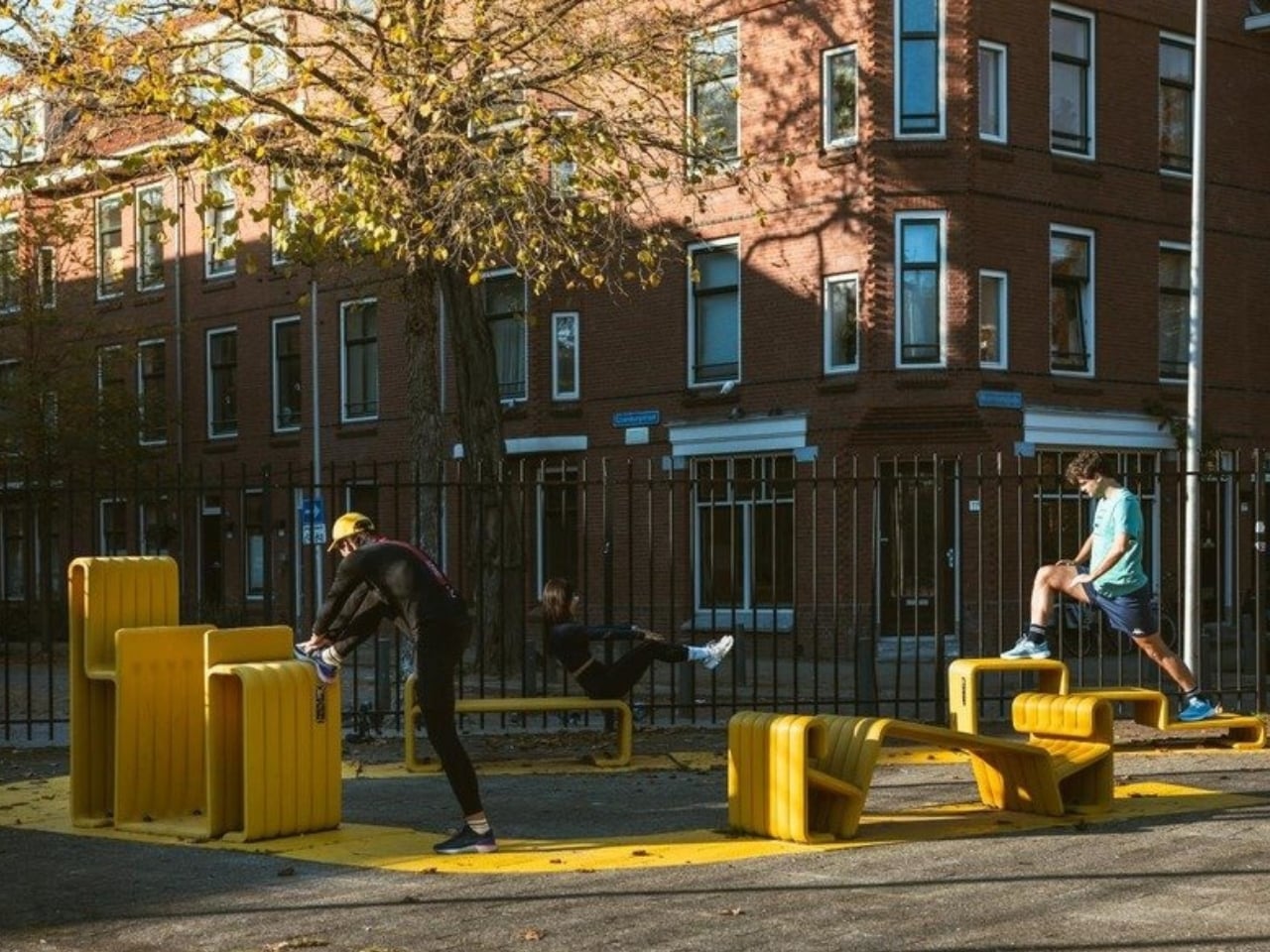
Here's a public fitness installation that doesn't look like it was assembled from leftover scaffolding and bad intentions. Gym Elements, by Rotterdam studio The New Raw, is a set of outdoor exercise objects printed from recycled polypropylene, about 1,058 pounds of it, and they look like someone sanded the corners off a playground and gave it a purpose. I want to touch one. That's the thing: most gym equipment is designed to be ignored until you need it. These yellow curves ask you to stop and figure them out. It's the same impulse that makes us want to open a Fujifilm's throwaway camera gets rebuilt brick by brick, the object itself becomes the invitation. But where that camera is a replica built for nostalgia, these are production pieces meant to live outside for years, collecting dust and UV fade and the occasional kid who stands on a platform meant for stretching.
The City of Rotterdam commissioned this for the Yellow Carpet initiative, a five-kilometer walking and running route that threads existing and new fitness spots together. That context matters more than the shapes. A gym behind a door requires intention. A gym along a path you were already walking requires only curiosity. You can do three stretches and keep moving. You can let your kid climb on it while you catch your breath. The equipment doesn't demand a membership or a schedule or any knowledge of what a lat pulldown is. It's just there, broad and yellow and textured with the fine lines of the printing process, and it doesn't care if you use it wrong. This is the kind of design that makes me wonder why more cities don't ask for both utility and presence. This folding gadget skips the apps and names the bird instead works on a similar principle: the tool doesn't hide its function behind a screen. Gym Elements doesn't hide its construction behind a coat of paint. The material is the finish. The ribs and layers are the decoration.
The recycling story earns its place here because The New Raw backs it up with production choices that matter. Single-material construction. No adhesives or coatings. Misprints and leftovers get reprocessed. Those details make the recycled content feel like a strategy rather than a label. But circularity still needs an exit plan. A recyclable object sitting in a public square needs someone to collect it, process it, and turn it back into something useful when its working life ends. The studio acknowledges that the layered surfaces will collect particles and that UV stabilizers only delay fading. Maintenance is part of the deal. I appreciate that honesty because it's the detail everyone else scrolls past. A bright yellow object in a city park looks great in project photography. Keeping it looking decent in year four is a different problem.
The strongest argument Gym Elements makes is that a piece of exercise infrastructure should contribute something to a neighborhood even when nobody is exercising. A row of gray steel machines bolted to concrete does its job and nothing else. These yellow forms sit in the landscape like sculptures that happen to support a push-up. The real test isn't whether the design holds up in a gallery, it's whether someone carrying groceries stops, puts down a bag, and puts a palm against that warm yellow surface because the shape finally made it feel okay to try.