
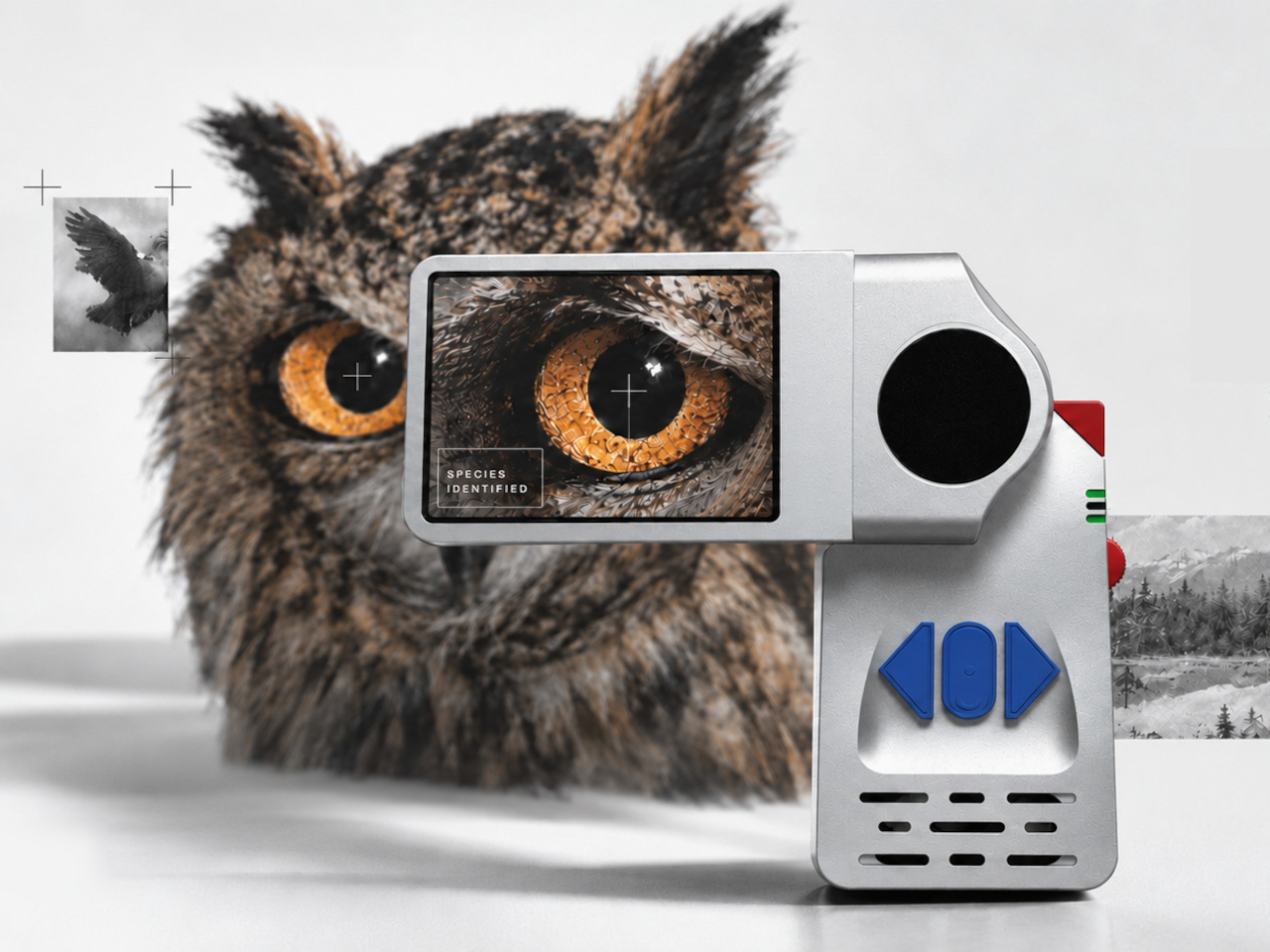
A dedicated nature gadget is a hard sell when your phone already has a camera, a search bar, and a growing library of apps that promise to name what you point it at. The log handheld concept from designer Maanit Singh makes the case anyway, and it does so by betting everything on the shape of the thing. Closed, it's a slim rectangle with a circular hinge. Open, the screen swings sideways above the grip, turning the device into an L-shaped tool that separates what you see from how you hold it. That change matters more than you'd expect. It gives the object the character of an old camcorder rather than yet another phone-slab pretending to be something else, and that alone makes it worth paying attention to. The silver shell, the blue directional buttons set into a recessed area, the red accents, they all suggest a device you operate by pressing, not swiping, which is exactly what you want when your thumb needs to stay steady and your eyes need to stay on a bird that might fly away at any second. Peak Design's new iPhone add-on is the pocket tool your phone didn't know it needed proved that a well-designed physical attachment can earn pocket space alongside a phone. Log is trying to earn that space by replacing the phone entirely for one specific job.
The proposed electronics, an ESP32-S3 controller, a camera module, a 2.8-inch TFT display, and a 4,000mAh battery, are paired with a speaker and two vibration motors whose exact behavior isn't explained. That lack of explanation is fine for a concept, but it's also the part that demands the most skepticism. The AI species identification is the whole point, and the presentation doesn't establish its accuracy or whether it needs an internet connection to work. A species name on a screen should be a starting point for learning, not an unquestionable answer, especially with fungi and plants where recognizing a resemblance isn't the same as knowing what's safe. The hardware development, wired electronics, cardboard hinge studies, a 3D-printed housing, shows someone thinking hard about the moving joint that has to support a screen while you hold the grip and then fold back into a compact shape. That's the hard part, and it's the part that makes the concept feel real. The hinge is the razor clam here, the narrow detail that everyone else scrolls past. If it doesn't work, the whole thing is just a phone with a weird case. If it does work, it changes the ritual of stopping to look at something.
The field log is the quietest and most compelling feature. Instead of leaving every sighting buried among screenshots and lunch photos, you'd have a dedicated collection to revisit, turning a short walk into something you can keep exploring afterward. Flint's paper battery is real and it doesn't need lithium showed us that a weird material choice can make a device feel genuinely new. Log's material choice is less weird, it's plastic and metal, but its interface choice is the real innovation: a device built around recording rather than searching. You'd still be looking at a screen. The hope is that you'd put it away with a better reason to look up.
The concrete question is whether the hinge and the field log are enough to pull someone away from the phone that's already in their pocket. That's a harder sell than it sounds, because the phone isn't just a camera and a search engine, it's also the thing you use to text someone about the bird you just saw. Log doesn't try to solve that. It just offers a different way to start the encounter. For the person who already circles back to a sighting, who wants to keep a record that isn't mixed in with grocery receipts, that might be enough. The hinge has to hold. The AI has to earn its trust. But the idea of a tool built around observation rather than distraction is worth watching, especially if someone actually builds it.