
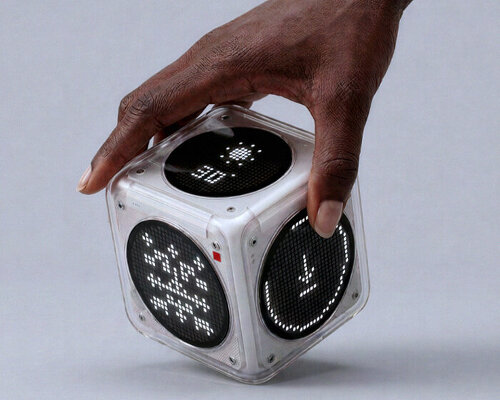
You know what I love about the Glyph (1) concept? It doesn't try to sell you a future it can't deliver. It's a cube. A transparent polycarbonate cube with rounded corners and an LED matrix on every face, and it talks to you without a single screen. That's it. That's the whole pitch, and it's more honest than half the launch videos I've watched this month. Industrial designer Adam Miklosi designed this as a speculative concept for Nothing, the brand that already makes its hardware feel like a prop from a 2001 sequel, and he's asking a genuinely interesting question: what if an AI companion didn't need a screen to be useful? It's the kind of question that makes you wonder why we're still staring at rectangles all day, and it pairs neatly with something like this mushroom camera asking what we should really be throwing away, which also wants you to rethink the objects you carry.
The device works by rotation. Flip it so a specific face points up, and that face's mode activates, smart-home controls, audio playback, a timer, or the AI voice assistant. No sub-menus. No swiping. No notifications that demand your attention at 2 a.m. The LED matrix on each face shows you what you need: playback status, an alert, a prompt. That's it. There's something almost feral about the simplicity, a return to the idea that a tool should sit in your hand and respond to a physical gesture, not demand that you unlock a glass slab and scroll. I'm reminded of the Vizio Mini LED that ditches the smart TV nonsense and just lights up well; both products are saying the same thing, just at different scales. Stop layering complexity on top of complexity. Give me the thing that does one thing and does it without a menu.
But here's where Spoot's gently skeptical ear perks up. This is a speculative concept. It doesn't ship. Adam Miklosi is a designer, not a manufacturer, and Nothing hasn't announced any plans to produce it. The transparent shell, the exposed inner chassis, the orientation sensors, the matrix lighting, all of it lives in renders and a design brief. That's fine. Concepts are allowed to exist as ideas. But if you're the kind of person who already had a tab open on this, wondering when you can buy one, the answer is: you can't. Not yet. Maybe not ever. And that's actually the most interesting part of the story, because the Glyph (1) isn't really a product. It's a provocation. It's asking whether we're ready to trust an AI companion that doesn't show us a face, doesn't scroll through a feed, doesn't tempt us to check one more thing before bed. It's a box that glows when you turn it, and it expects you to know what that glow means without having to read a label.
The specific consequence to watch is whether Nothing, or someone else, picks this up and builds it. Because the moment a screenless AI companion actually ships, the entire conversation about how we interact with smart devices shifts. We stop designing for the eyes and start designing for the hand. That's a razor clam of a detail hiding just below the surface of this glossy render, and it's the one worth circling back on. Stay spooty.