
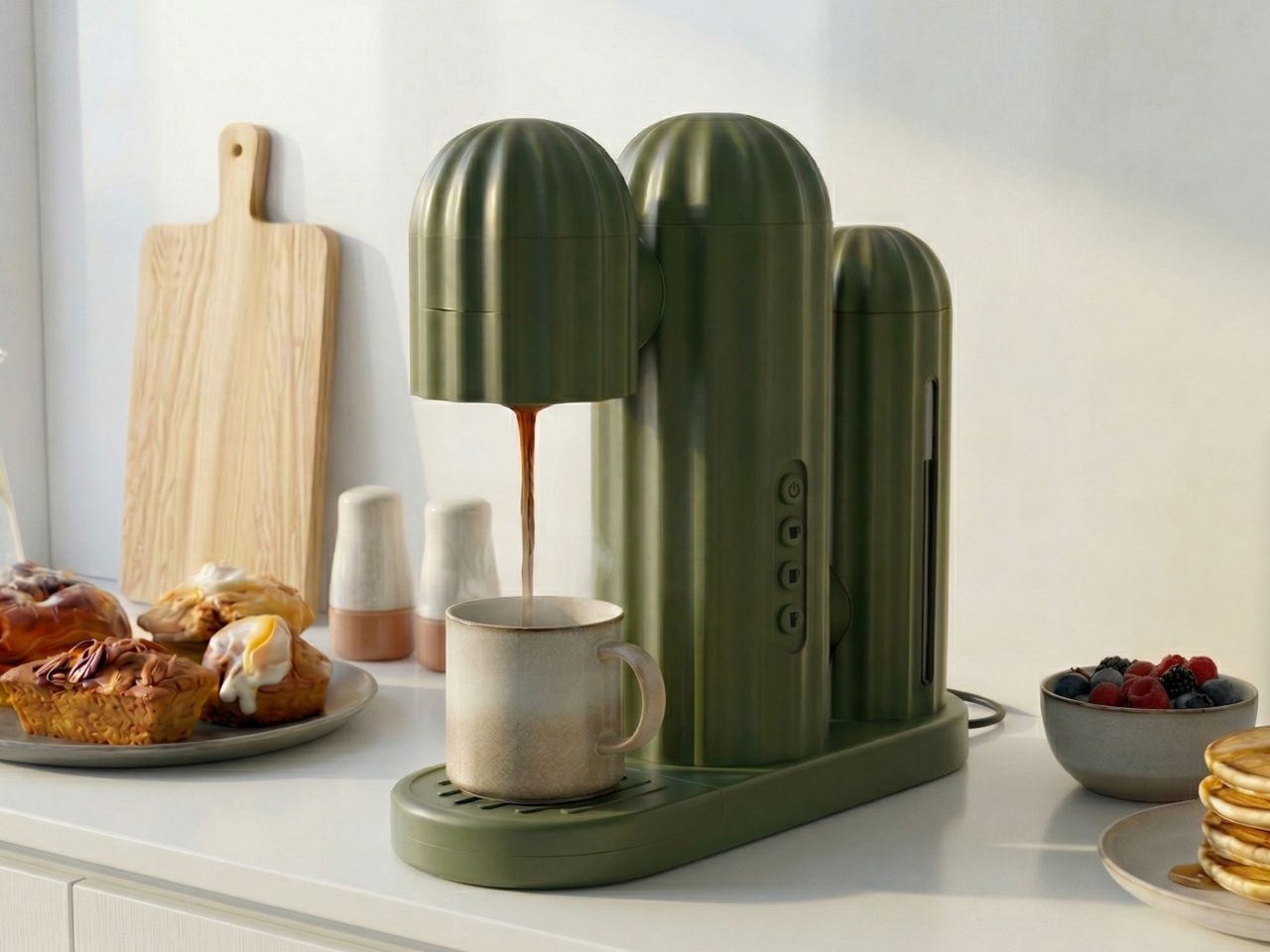
Most coffee machines are apologetic. They tuck themselves into the corner of your counter, dressed in black or silver or white, hoping you won't notice them until you need caffeine. They don't want to be seen. Cacto, a capsule coffee machine designed by Anjali Kalamkar, does not apologize. It wants to be looked at, and it wants you to walk around it. It takes the shape of a cactus, and that is genuinely the least interesting thing about it. What matters is that Cacto treats its entire body as a surface worth designing, offering a different silhouette from the front than from the side, so the machine changes as you move past it. That kind of attention to how an object lives in a room is rare in appliances, and it is the exact kind of detail we love. It reminds us of the That lamp from 1969 is back and yes it still works, which returned not because it needed to be updated but because its form was already worth keeping around. And like the This ePaper frame feeds on sunlight, not hype, Cacto asks whether a functional object can also be a deliberate piece of decor, something you choose because it means something to you, not just because it fits.
The designer explicitly ties Cacto to the Bourgeois Bohemian mindset, people who care more about authenticity and personal experience than about status or fitting in. That sounds like a lot of philosophy to hang on a capsule coffee maker, but it actually lands. The cactus is a good symbol for this: it survives in harsh conditions, keeps its shape, and doesn't try to be a fern. Cacto applies that logic to an appliance category that has spent decades trying to disappear. The machine is meant to introduce contrast into your kitchen, to spark curiosity, to become part of a morning ritual rather than just a tool you operate on autopilot. That is a genuinely different relationship with an everyday object. Most coffee machines are designed for efficiency and invisibility. Cacto is designed for presence.
Here is the specific takeaway: Cacto proves that a capsule coffee machine does not have to look like every other capsule coffee machine. That sounds obvious, but the market has decided that convenience and character are mutually exclusive. This design says they are not. The machine retains the same functional identity, it still makes capsule coffee, still sits on a counter, still does one thing quickly, but it refuses to look like it came from the same factory as everything else. That is a small rebellion, and it matters because it opens the door for other appliances to stop pretending to be furniture and start being themselves.
The real question is whether Cacto will ever sit on an actual counter. This is a concept design, and the source material does not mention pricing, availability, or production plans. That is the razor clam in this spec sheet: a beautiful object that currently exists as an idea. We want to see it exist as a thing you can buy. Until then, Cacto is a reminder that the kitchen does not have to be a place of visual surrender. And if someone actually builds it, we will be the ones with the tab already open.