
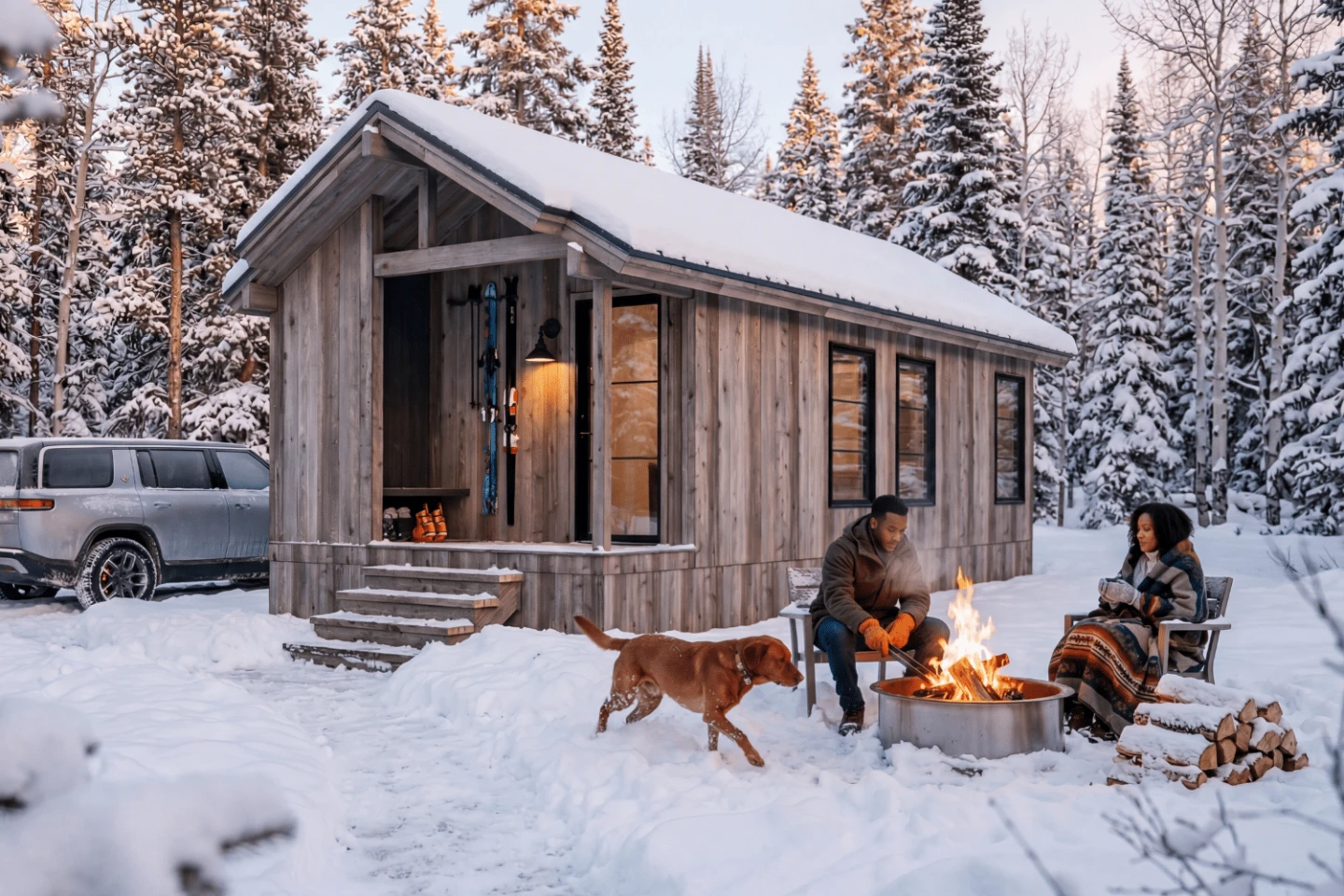
There's something quietly radical about a tiny house that doesn't try to look like a spaceship. The Yukon Park Model takes the silhouette of a mountain lodge, steep roof, warm wood, the kind of place you'd find a cast-iron stove and a stack of dry firewood, and puts the whole thing on wheels. It's a retreat for two, and it's refreshing precisely because it refuses to pretend it's anything else. No folding walls, no hydraulic lifts, no transformation sequence. Just a cabin that can move.
That honesty matters because the tiny house world is full of clever contortionists. Take the Helena tiny house refuses to fold up small and that's exactly why it works, which similarly declines to collapse into a neat little box, but for entirely different reasons. The Helena is built for people who want to travel the world, so its refusal to fold is a feature, it prioritizes livable space over portability. The Yukon Park Model, by contrast, doesn't seem interested in crossing continents. It's aimed at someone who wants a permanent-feeling second home that happens to be towable. That's a narrower ambition, but it's also a more honest one. Not every tiny house needs to be a globe-trotting adventure pod. Some just need to sit quietly in the woods and hold two people and a cup of coffee.
The open layout is the smartest move here. Most tiny houses fight for every square inch by compartmentalizing everything into designated zones, sleeping loft over kitchen, bathroom the size of a phone booth. The Yukon Park Model apparently lets the space breathe, which is exactly what you want when the whole point is to feel like you've escaped into a cabin, not into a closet. It's worth comparing this to the Lavvu Stuff a Full Bathtub Into Their Tiny Home XL, which takes the opposite approach: cramming a full-size bathtub and hidden storage into a tiny footprint. That's impressive engineering, but it's also a different kind of problem-solving. Lavvu is asking how much luxury you can compress. The Yukon Park Model is asking how much spaciousness you can preserve. Both are valid, but they serve different people.
So who is this for, really? Someone who wants a weekend escape that doesn't require a hotel booking or a mortgage on a full plot of land. Someone who wants the aesthetic of a mountain lodge without the permanence of a foundation. The question is whether the open layout works as well in practice as it sounds on paper. A tiny house that feels spacious when it's empty can feel very different when two people are actually living in it, cooking, sleeping, trying not to trip over each other. That's the detail to watch. The Yukon Park Model has the right idea. The execution will determine whether it's a clever retreat or a cramped reminder that wheels have limits.