
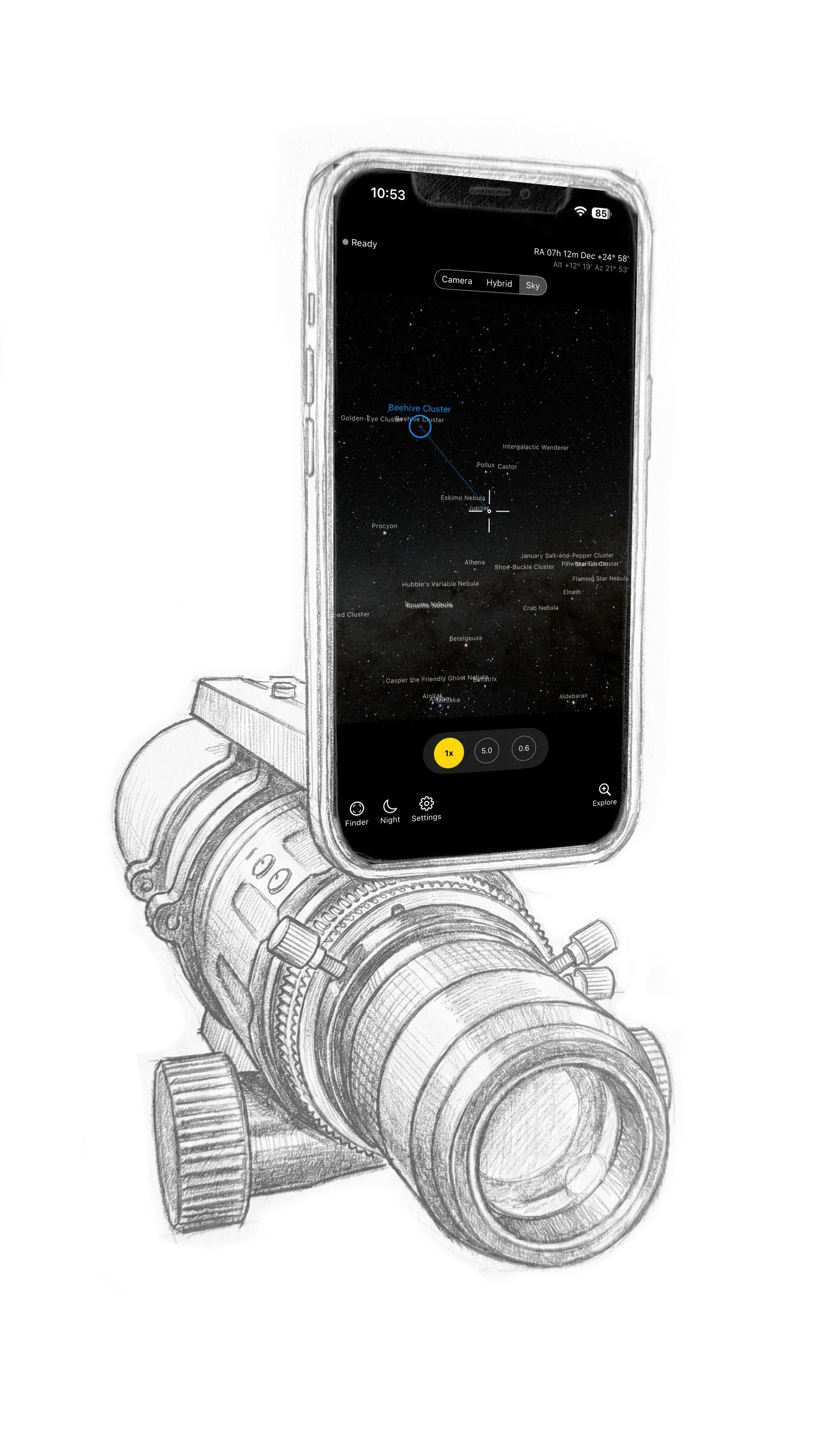
AstroHelm is exactly the kind of quiet, practical miracle that makes you wonder why nobody thought of it sooner, and then you remember, oh right, because it's actually hard. An amateur astronomer in New York City, staring up at a sky thick with light pollution and distracted by the usual chaos of phone sensors that can't tell a star from a streetlamp, decided to sidestep the whole problem. Instead of trying to make the phone's gyroscope and magnetometer work well enough (they never do in a metal box of a city), he taught it to look at a picture of the sky and recognize where it is by the pattern of stars. That's plate solving, a technique that's been around for professional observatories for decades, and it has just been smuggled into your pocket.
What this means for anyone who has ever aimed a telescope at "roughly that bright bit" and hoped for the best is that the object you're hunting for will actually land in the eyepiece. The app, AstroHelm, is free, runs entirely on device (no internet, so no waiting for a server in a cold field), and hands you a simple arrow to follow. It's the same kind of back-pocket upgrade we've seen in other unexpected corners of phone life, the way The Selfie Camera on Your Phone Has Always Been in the Wrong Place turned a design oversight into a clever fix, or how The Freckle phone hands kids a field guide, not a leash repurposes a screen into a tool for exploration. The phone is the chassis; the smart part is someone deciding to use it for something it was never designed to do, and doing it better than the hardware intended.
We like this one because it didn't swallow the hype it could have. The developer tried machine learning first, honestly, and found that traditional computer vision was better at pulling stars out of images that also contain buildings and trees. That is a genuine, nerdy, Spoot-worthy detail: the older method won because it was more reliable in messy real-world conditions. The app is free, with optional one-time purchases for more objects and interoperability with other astronomy software, and the developer is partnering with astronomy clubs to offer free licenses for outreach. That's not a flashy press release. It's someone who knows that the barrier to seeing the night sky is not just hardware, it's knowing where to look, and not wanting to spend $300 to find out.
The open question, the one worth watching, is how well the algorithm holds up when you point a phone camera through a cheap telescope in a moderately light-polluted suburb, or on a night when clouds are playing games. The developer says traditional CV methods performed better, which is encouraging, but the real test is always the first night you take it outside, shivering, and the arrow points true. That's the razor clam in this spec sheet: plate solving worked because the phone and the optics are rigidly connected, and the app assumes you've got that connection. Clamp it right, and the sky opens. Clamp it wrong, and you're just another person staring at a phone in the dark. But for the price of free and the promise of a star you can finally see with your own eye, that's a gamble worth taking.