
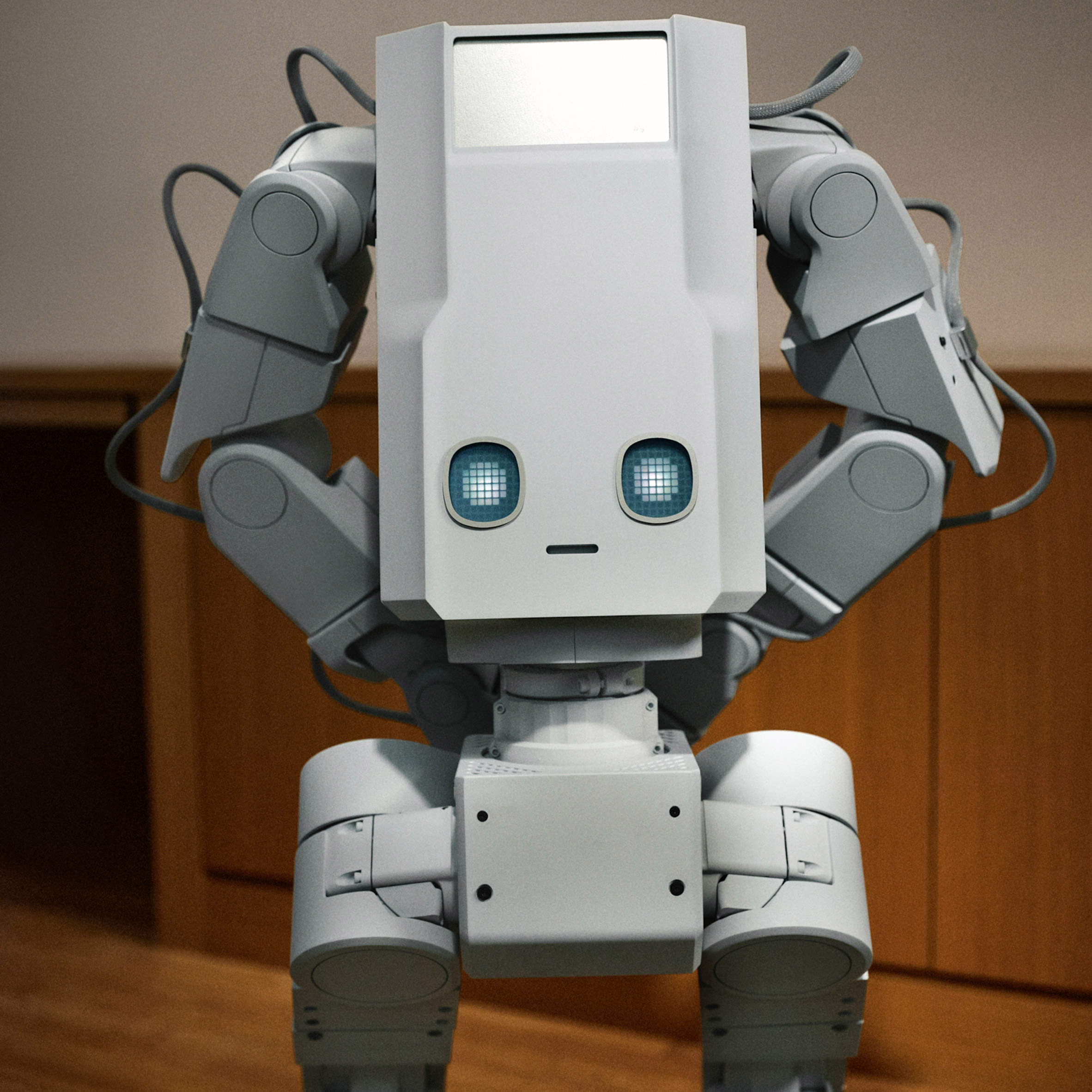
Tuesday Labs just did something almost nobody in robotics has the nerve to do: they made a $20,000 robot that doesn't try to look like us, and they're betting that's exactly why we'll let it water our plants. The Voxel Series-1 is a cuboid, counter-height droid butler with LED eyes and one-degree-of-freedom grippers, and it's the most honest home robot we've seen in years. While Apple's robot arm finally gives the HomePod something to reach for, Voxel is already reaching for your broom, but without the existential weight of a machine that wants to borrow your face. This is the razor clam in the spec sheet: Tuesday Labs understood that the uncanny valley isn't a design flaw you fix with better skin texture; it's a signal that you built the wrong thing.
Founder Rosalind Shinkle, who cut her teeth at Boston Dynamics, worked with a former Pixar character designer to land Voxel on a very specific spectrum between "human" and "toaster." The result is a robot that looks like a piece of luggage that decided to help out, a maximalist, playful, lightweight shell that signals exactly what it can do. Shinkle calls this "affordance matching," and it's the smartest thing in the press release. When you see Voxel, you don't wonder if it can fold your laundry or pour you a drink (it can't, yet). You see a machine that waters plants and sweeps crumbs, and that's exactly what it does. Compare that to the parade of humanoid robots that promise everything and deliver disappointment, and Voxel starts to look like the only robot in the room that knows its job description. These robot vacuums scrub floors while Prime Day scrubs the price, but Voxel isn't trying to be a vacuum, it's trying to be a character you don't mind living with.
The $20,000 price tag is not a typo, and it's not a secret. Tuesday Labs is starting with early adopters who will help train Voxel's autonomous software at home, which is a polite way of saying you're paying for the privilege of being a beta tester with a very expensive, very charming brick. Shinkle is upfront that the ambition is to scale and bring costs down, but right now Voxel is a luxury product for people who want to shape what home robotics becomes. That's fine, early adoption has always been expensive and weird. The question is whether Voxel's design philosophy can survive the transition from luxury curiosity to accessible tool. Voxel's $20K legs will find your lost keys and fold your laundry, but only if the software catches up to the hardware's promise.
Here's the takeaway: Voxel is a bet that the most important thing a home robot can do is not make you uncomfortable. That sounds simple, but it's the hardest problem in the room. Every other company is racing toward a humanoid future, and Tuesday Labs is building a box with eyes and calling it a butler. If Voxel works, if it actually waters your plants without tipping over and sweeps crumbs without getting confused by a rug, it will have proved that the uncanny valley isn't a hazard to navigate, it's a cliff to walk away from. The detail to watch is whether the early adopters actually help train the thing, or whether Voxel stays a charming, expensive paperweight. Shinkle hates cleaning her apartment, and she built a robot to solve that problem once and for all. We're watching to see if Voxel hates cleaning it too.