
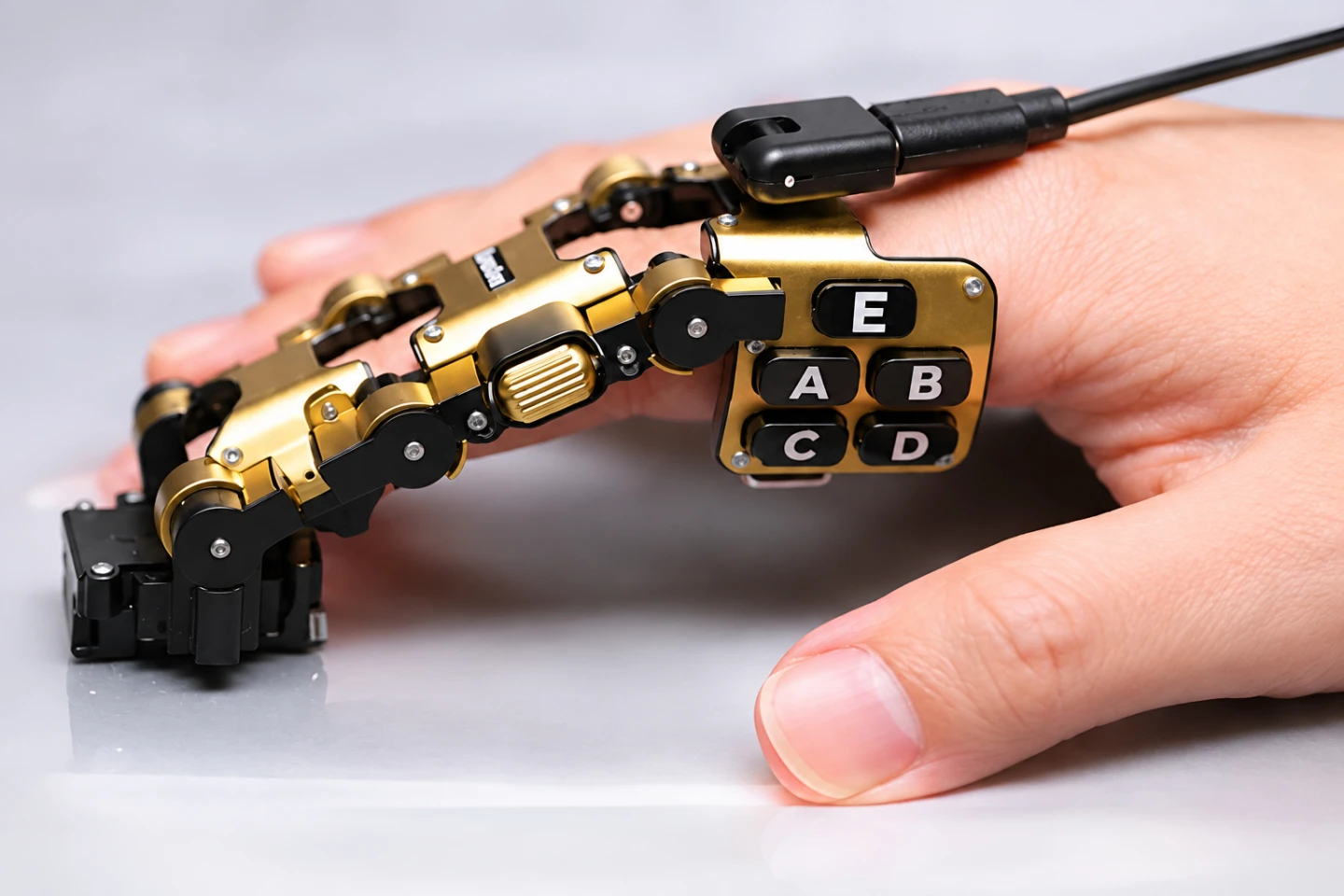
I want to hold the Borslon gaming mouse, but I'm not sure I want to click it. That's the tension here, and it's a familiar one for anyone who has watched a That candy-colored keypad hides a 4G phone that forgot social media campaign sail past its goal only to wonder, months later, whether the thing actually shipped. The Borslon wraps around your finger like a curious crab, which is the kind of sentence you write when a product designer has genuinely thrown out the reference manual. It's not a mouse in any traditional sense, no palm rest, no skates, no cord snaking across the desk. It's an articulated shell that clamps onto your digit and lets you click by curling your fingertip. The press images show it perched on a hand like a tiny metallic mantis, and honestly, the look is the whole reason I'm still reading. But the look is also the reason I'm skeptical.
Nobody asked for a finger-worn gaming mouse. That's exactly why it's interesting. The best weird hardware starts from a place of "what if" rather than "what sells," and the Borslon is clearly a what-if project. What if you could aim by rotating your wrist instead of dragging your arm? What if the mouse became an extension of your hand rather than a slab you push around? Those are legitimate ergonomic questions, and the Borslon's articulated design suggests someone has spent real time thinking about them. But here's the razor clam: this is a Kickstarter campaign, backed by a xxKickbooster promotion, and the product is a radical mechanical departure from every gaming mouse on the market. That's a lot of variables for a crowdfunding backer to absorb. The Spoot digs into the Flipper One Kickstarter, a pocket Linux computer shipping in 2027 taught us that even well-funded campaigns with established teams can push timelines into absurdity. The Borslon doesn't have an established team. It has a render and a promise.
The practical question for anyone reading this is simple: do you want to be the person who backed the crab mouse, or the person who waited for the reviews? I lean toward the latter, and not because I lack curiosity. I have a tab open on the Borslon right now. But the detail everyone is scrolling past is the one about actuation. How does a fingertip-mounted switch register a click when your finger is curled? What's the tactile feedback? Traditional mice use a mechanical or optical switch that collapses with a satisfying snap. A finger-worn device has to register pressure without the leverage of a palm behind it, and that's a mechanical problem that renders and prototypes solve differently. Until I see someone actually using this thing in a real game, not a staged demo, but a sweaty ranked match, I'm treating it as a fascinating concept that may or may not survive contact with actual human hands.
The Borslon is worth watching because it's weird, and weird is where progress hides. But it's also worth watching because it might fail in a way that teaches us something. The INFOBAR ZERO phone proved that a candy-colored keypad and a stripped-down OS can be genuinely delightful if the execution holds up. The Borslon needs to prove that an entirely new input paradigm can work without introducing a new set of problems. If it ships and it works, it changes how we think about ergonomic gaming peripherals. If it ships and it doesn't work, it becomes a cautionary tale about form chasing function too hard. Either way, the detail to watch is not the crab-like shape, it's the click. That's the narrow thing under the sand.