
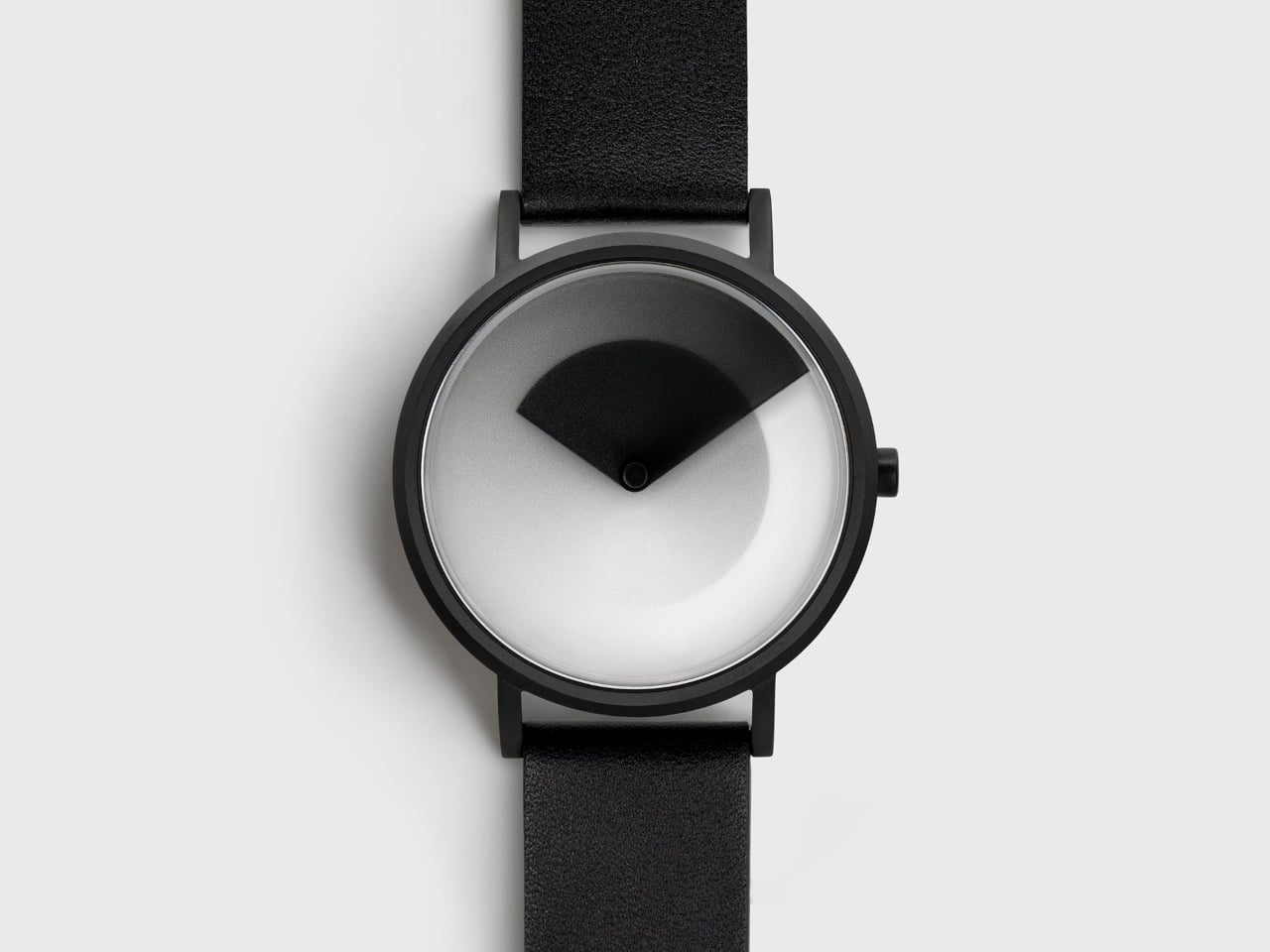
LAWA's Gradient Watch is exactly the kind of thing Spoot gets a tab open for before the press release finishes loading, and we think it's brilliant, but only if you know what you're signing up for. This is a watch that replaces hands with rotating semitransparent discs, letting overlapping gradients of light and dark tell the time instead of a pair of pointers. It is not an app on your wrist, it is not a screen, and it is not trying to be anything you already own. For the person who has already scrolled past a dozen smartwatch alternatives and wondered why none of them felt like a real break from notification culture, this one earns a closer look.
The trick is in the overlap. Two discs, one for hours and one for minutes, rotate on top of each other. Where their gradients combine, the dial gets darker; where they don't, it stays pale. The result is a changing composition that belongs to the mechanism itself, not to an animation playing behind glass. That is a genuinely clever hinge of an idea, the kind of narrow, slippery detail that makes you stop scrolling and stare at your own wrist for a moment. The designers, Ewa Bryzek and Allen Shakir at LAWA Design, have built something that treats time as a visual condition rather than a set of coordinates. It is nerdy, it is playful, and it is a little feral. But here is the concrete point Spoot wants you to hold onto: reading this watch is an interpretation, not a lookup. Without numerals, minute markers, or hands to line up against a scale, you are estimating the position of shaded areas. If you are counting down the minutes before a train leaves, that tradeoff matters more than how cool the dial looks in the product photography.
Inside the 1.5-inch 316L stainless steel case ticks a Japanese Miyota 2025 quartz movement, conventional, reliable, and refreshingly unambitious. No menus to navigate, no apps to sync, no notifications to silence at dinner. The black version keeps the strongest contrast inside the bezel, with a matte finish and pale dial that lets the gradients do the work. Navy Blue and Pine Green offer a cooler cast, while Silver, Gold, and Rose Gold change the case finish without changing the idea. Matching mesh bands extend the color along the wrist, and both leather and mesh straps use quick-release fittings, so swapping them requires no tools. The leather configuration weighs 1.48 ounces; the mesh comes in at 2.40 ounces. That is not a trivial difference if you wear it all day. The crystal is sapphire-coated mineral rather than solid sapphire, and the water resistance is 5 ATM, fine for splashes, not for swimming laps.
The specific detail to watch is whether the gradient overlap actually becomes legible in practice, or whether it stays a conversation piece that you check twice before telling someone the time. LAWA's Gradient Watch is not for everyone, and it should not pretend to be. It is for the person who already has a tab open on weird clocks, who wants the cool thing and the honest take, and who understands that sometimes the best way to know what time it is involves looking at a composition you have never seen before. That is the razor clam in this spec sheet: the watch works, but it asks you to meet it halfway. Whether that feels like a feature or a friction depends entirely on how much you enjoy the act of noticing.