
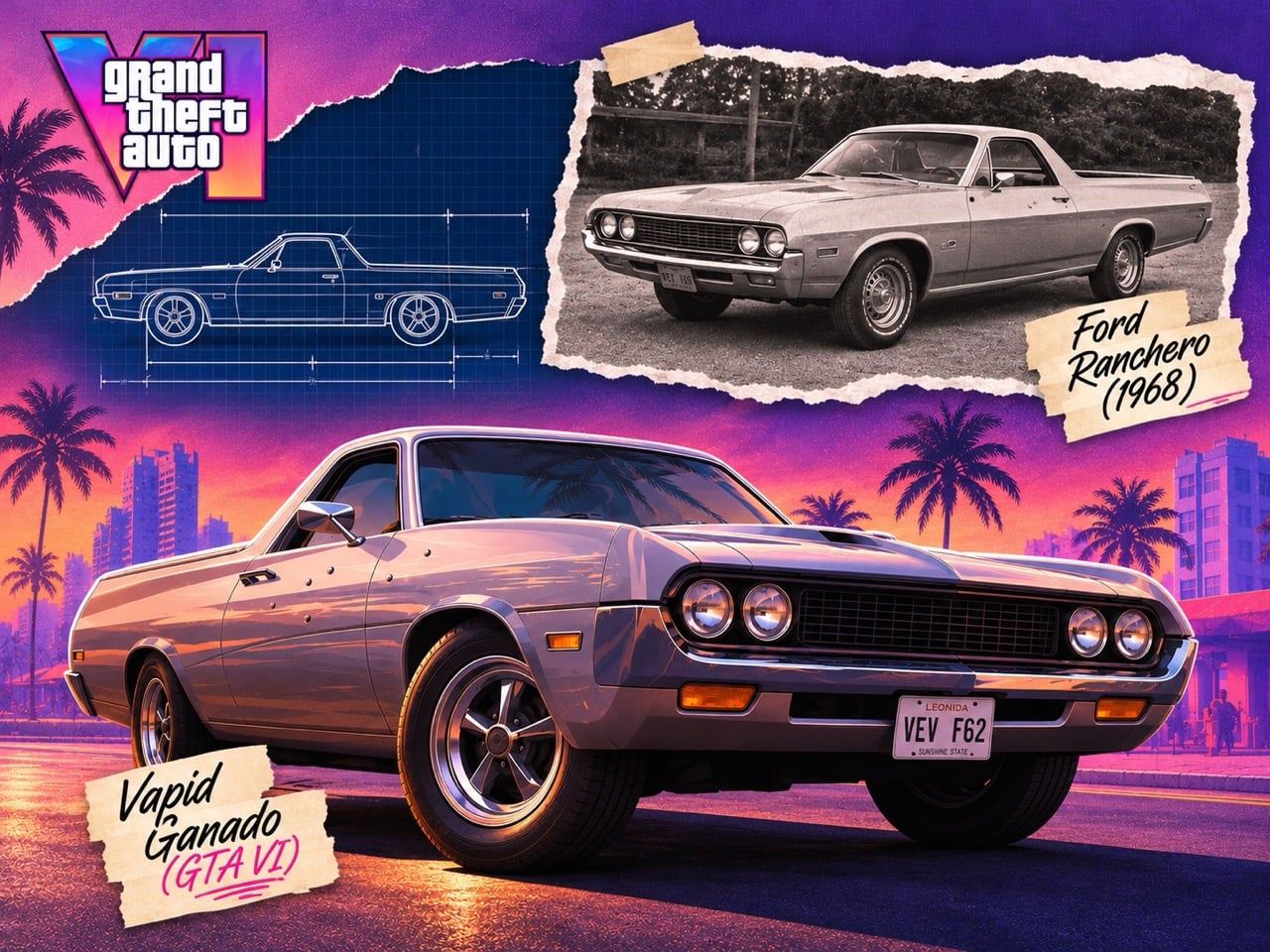
There's a moment in every GTA game where you stop stealing a car and start studying it. You circle the bumper, squint at the badge, and wonder which real car got kidnapped and reassembled this time. Rockstar's method, mashing two vehicles together and hoping nobody sues, as designer Frank Stephenson put it, sounds like a joke until you realize it's the most creative act of automotive forgery happening anywhere. And with GTA 6 arriving on November 19, the fakery has gotten good enough to earn real respect. Stephenson himself said one of these fakes looks more cohesive than the car it copies. That's the kind of praise you can't buy, and it's the kind of detail we live for, the razor clam buried in the spec sheet, the footnote that's better than the marketing copy. It reminds us of the way Keychron's new mouse lets you nudge the trackball to exactly where your thumb lives, a tiny ergonomic choice that most people would scroll past, but that changes everything once you notice it. Rockstar is doing the same thing with headlight bulbs. Leaked footage suggests older cars fade their incandescent bulbs out gradually while newer ones snap their LEDs off instantly. That's not a feature anybody asked for. That's a design team that cares about the difference between a 1995 Grotti and a 2025 one, and it's exactly the kind of obsessive detail that makes this whole fictional ecosystem work.
The real trick isn't just that Rockstar builds fake cars. It's that those fake cars now have fake family trees. A Grotti from 1995 has to look like a Grotti, which is a sentence that should make zero sense and somehow makes complete sense. The Dinka Jester RR, the Supra clone Stephenson praised, carries decades of design DNA that Rockstar invented whole cloth. The Benefactor Schafter blends three generations of real Mercedes into one believable sedan. The Pfister Comet Retro Custom wears the riveted fender flares of Akira Nakai's Rauh-Welt Begriff builds, a deep cut so specific that only people who obsess over Japanese widebody Porsches will catch it. Rockstar is designing for the people who modify cars, not just the people who drive them. That's the same audience that loves OPPO's Find X10 hands you 200 megapixels and asks where your tripod's been hiding, the crowd that wants the tool that lets them do something weird and personal, not just the tool that works out of the box. Rockstar's artists aren't copying cars. They're reverse-engineering brand DNA from the outside, then proving they got it right by building something new that still reads as a Benz or a Lambo at a glance. That's harder than licensing the real thing, and it's why these fakes feel more alive than most licensed cars in other games.
Then there's the part that makes us laugh every time we think about it. Rockstar had West Coast Customs build six of GTA 6's cars for real. Not renders. Sheet metal. The Bravado Banshee crossed over back in 2013 when a real Dodge Viper was rebuilt to match the digital parody, and then sold at auction for $30,800, a fraction of what the modifications cost. Now the Grotti Cheetah sits at Selfridges London with a £1 million price tag, wearing a blue-to-pink Vice City fade and a rearing rabbit where Ferrari's prancing horse would sit. Real carmakers spend a century earning that recognition. Grotti did it without building a single car, until now, when somebody actually did. It's the same loop that makes Fujifilm's throwaway camera gets rebuilt brick by brick so satisfying: the digital thing becomes so beloved that somebody has to make it physical, just to prove it can exist. Rockstar's designers even went endurance racing for real, winning their class at the Nürburgring 24 Hours in a stripped BMW 325i, then feeding those lessons into GTA Online's tuning systems. That might be the coolest research trip in gaming.
Here's the concrete takeaway: GTA 6 will contain the most complete fictional automotive ecosystem ever built, with manufacturers that have back catalogs, performance variants, and multiple generations of the same nameplate, and you will