
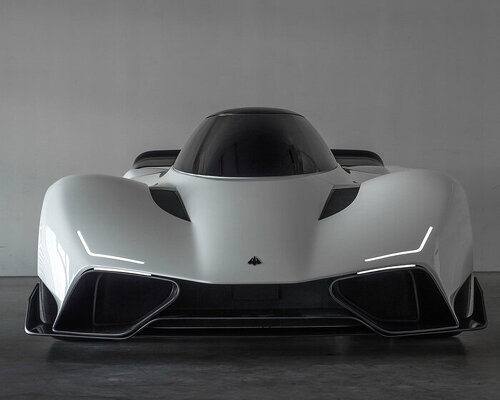
The Sanrivatti ONE is a genuinely weird idea that might actually be onto something, and that alone makes it more interesting than ninety percent of hypercar concepts that roll out with the same reclined cockpit, the same V12, the same press-release poetry about "unbridled performance." Moving the driver forward, head-up, into something closer to a MotoGP rider's posture isn't a styling flourish; it's a fundamental renegotiation of what it means to be inside a fast car. Sanrivatti claims the Apex Position gives you 3.2 times more of the circuit in view at Silverstone's Corner Three compared to ten benchmark hypercars, and a vertical field of view of 28 degrees against 15.5. Those are numbers worth staring at. They suggest that the company is thinking about visibility as a performance metric, not a comfort checkbox, and that's the kind of detail that makes you wonder why nobody asked the question sooner. It reminds us of the way Project ARES puts 250 real electric motorcycles on the road, not just renders, another project that prioritizes physical experience over pixel-perfect marketing. And we love that Sanrivatti cites the peregrine falcon and modern fighter aircraft as references, because the silhouette genuinely looks shaped by the body inside it, not draped over a chassis plan.
But let's get to the part the launch video probably skipped. The naturally aspirated 5.5-liter Judd V10 targets 800 hp and 700 Nm, paired with a six-speed Hewland sequential gearbox and a projected dry weight of 1,100 kg. These are provisional figures, and Sanrivatti says so plainly. That matters because a hypercar built around a forward-driving position introduces real questions about neck strain under braking, helmet clearance, and whether your peripheral vision actually helps when the G-forces start stacking. The company claims a more open field of vision and a heightened perception of acceleration and cornering, which sounds great on a render, but the proof will be in how a human spine handles 1.5 Gs of deceleration from a head-up posture. It is also worth noting that the ONE is rear-wheel drive with a sequential gearbox, which suggests an experience closer to a track-day tool than a luxury cruiser. This is not a car for the person who wants to arrive at a hotel lobby. It is for the person who wants to feel the corner before they see it, which is exactly the kind of person who might also appreciate Kenko's pieni III has no screen and no idea what you're pointing at: perfect, a device that forces you to engage with the act itself rather than the preview.
The specific detail to watch is the canopy. That single-piece, forward-integrated canopy is the hinge point of the entire concept. If it works, if it provides the visibility Sanrivatti claims without turning the cabin into a greenhouse or a claustrophobic tube, then the ONE will have done something genuinely novel. If it doesn't, the whole Apex Position argument collapses into an interesting footnote. Either way, Sanrivatti has earned the right to be taken seriously by actually stating its targets, citing its benchmarks, and admitting these are provisional. That is rarer in hypercar announcements than a clever hinge.