
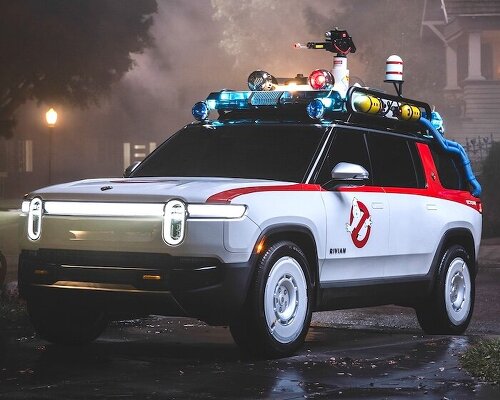
Rivian just turned its electric vehicles into Ghostbusters machines for Halloween, and honestly? This is the most interesting thing an automaker has done with a software update all year. Not because it's practical, it's gloriously impractical, but because it proves that when a car's hardware and software are built to talk to each other, the car can become something entirely different for a few weeks. That's a bigger deal than it sounds like. Most EVs are still trying to convince you they're serious transportation appliances. Rivian is out here asking whether your SUV can also be a prop from a 1984 comedy, and the answer, it turns out, is yes.
The update, available from October 9 to November 2, turns R1T, R1S, and R2 models into interactive ghost-hunting machines with synchronized exterior lights, slime-green screens, hidden ghosts to find in the menus, and an arcade game called Mallow Mash where you catch Stay Puft marshmallows on the touchscreen. The voice assistant gets a creepy makeover. There's a Trick or Treat Mode that greets visitors with music and light shows. None of this is permanent, it vanishes after November 2, and the more elaborate features only work while parked. But that's exactly the point. Rivian is treating its vehicles like platforms rather than finished products, and that philosophy has implications far beyond Halloween. It's the same kind of thinking that makes you wonder what else is possible when a car's lighting, audio, and interfaces are all software-controlled. We've covered Six tiny EVs that dare to be small, sharp, and actually cool before, and what those little cars share with Rivian's approach is a willingness to question what an electric vehicle has to be. Rivian just answered: something that can hunt ghosts for a month and then go back to hauling camping gear.
The physical Ecto-R1 built by Rivian's Special Projects team is the showpiece, a white R1S with red graphics, vintage emergency lights, a radar dish, and a promotional film starring Bill Murray, but the real story is the software. This is the third Halloween update Rivian has done, and each one has pushed further into treating the vehicle's existing hardware as a canvas. The exterior LEDs, the screens, the speakers, the voice assistant: none of them were added for Halloween. They were already there. Rivian just found a new way to orchestrate them. That's a genuinely clever use of the fact that modern EVs are, underneath the sheet metal, computers with wheels. The scavenger hunt inside the menus, where you find hidden ghosts by poking around driving modes and security settings, is a delightful bit of design that rewards the kind of idle curiosity Spoot readers already have. You know the feeling: you're the one who digs into the settings menu before you've even driven the car. Rivian built a game for exactly that impulse.
Here's the concrete takeaway: Rivian has demonstrated that an over-the-air update can fundamentally change the personality of a vehicle for a limited time, and that has consequences for how we think about car ownership. If a car can become a Ghostbusters machine for three weeks, it can also become something else, a mobile cinema, a concert venue, a security system with a sense of humor. The question Rivian's Halloween stunt raises is not whether it's silly (it is, gloriously), but who else will treat their vehicles as platforms rather than finished sculptures. The update disappears November 2. Watch what happens when it does, and whether other automakers start paying attention to what Rivian just proved was possible with a few lines of code and a lot of nerve.