
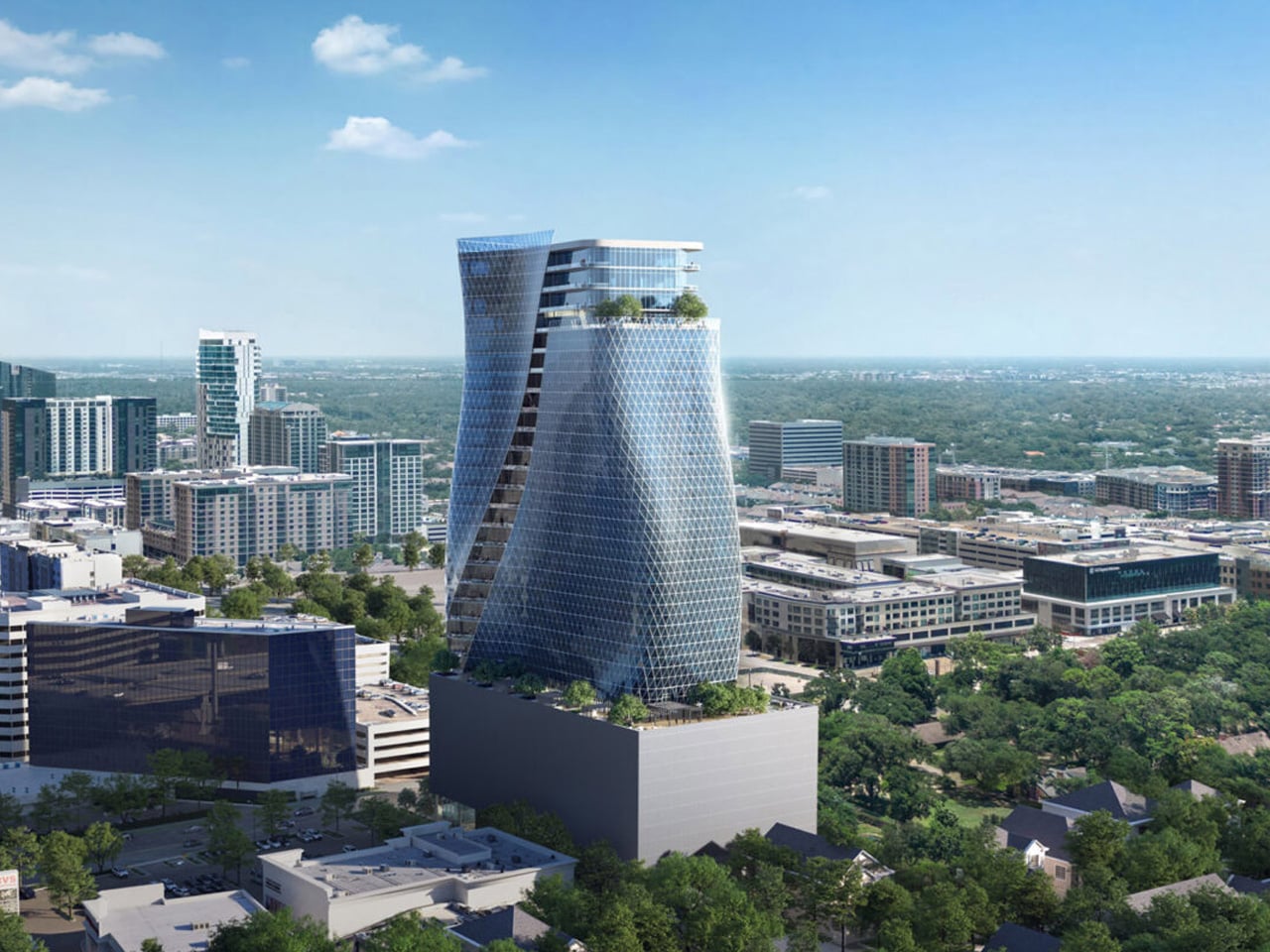
Houston is about to get a building that looks like it's holding its breath. The proposed O27 skyscraper, designed by STG Design for developer Broadview Real Estate, wraps a 32-story office tower in triangular glass panels that follow a swelling, pinched silhouette, making the facade read less like architecture and more like a slow-motion ripple. We've seen plenty of curved glass towers that lean on gimmickry, and we've tracked computational design tools that promise more than they deliver. But O27 is different: it's using intensive computational modeling to reconcile a genuinely weird exterior with floor plates that stay efficient and repeatable. That is the razor clam here, the narrow detail everyone else scrolls past. The building looks elastic, but the math underneath is rigidly practical. If it works, it means developers don't have to choose between a memorable skyline and a rentable floor plan.
The triangular grid isn't decoration. It breaks the curved elevations into smaller, legible facets, so your eye registers the change in curvature as the tower rises. In the renderings, those panels produce a shimmering surface that the developer says will shift throughout the day, an intention, not an observed property of a finished facade, but a plausible one given the geometry. Near the ground, the glazing sweeps diagonally toward the entrance; higher up, projecting terraces interrupt the smooth outline, giving you a sense of scale. The effect is sculptural, and the terrace edges are the detail that makes it readable from street level. That matters because the podium, a nine-story parking deck with a landscaped terrace on top, is a substantial part of the composition. A building this expressive can't just vanish into a parking garage. The entrance drive, designed by ALT + TAB, leans hard into theatrical hospitality: a water wall, a canopy embedded with fiber optics to evoke a night sky, golden lighting following the ceiling's curves. It's a luxury-hotel arrival for an office tower, which either feels like a smart bet on the River Oaks District or a lot of expensive ceremony for a building that hasn't broken ground yet.
That's the open question. Broadview is targeting completion in 2028, but told Bisnow that neither a groundbreaking date nor an equity partner has been finalized. O27 is an ambitious proposal, not a construction site. The most interesting promise, the reconciliation of fluid form and repeatable workspace, remains untested. If the computational design process delivers on its claim, every office level won't become a separate planning nightmare, and the triangular grid will do more than look pretty: it will make the geometry buildable. But if the math doesn't hold, or if the equity partner never materializes, this becomes another beautiful render that Houston's skyline never gets to hold its breath for. The detail to watch isn't the facade. It's the floor plate.