
The carrying handle on Jess Wiseman's CHEKT board is the detail that makes the design click for me, and it's the reason this thing deserves your attention before the inevitable wave of "smart chessboard" launches floods your feed. Chessboards have an awkward domestic life: leave one out and it claims a chunk of your table; put it away and playing becomes another thing to unpack. CHEKT addresses that friction with a clear enclosure and a slim, silver-colored handle, giving the whole thing a faint briefcase quality. That's not a gimmick. That's a board you can actually move without treating it like a fragile heirloom. For anyone who has ever shoved a magnetic travel set into a drawer and pretended that counted as a proper game, this is the practical upgrade you didn't know you were asking for.
What makes CHEKT more than a pretty slab is the layered shell system. The supplied images show four transparent outer shells with different graphic treatments, from yellow square outlines to red, dot-built chess-piece illustrations to blue circles and angular linework. That means you're not committing to one look forever. A board you can re-skin based on mood, room, or opponent is a genuinely better proposition than another beautifully finished piece of walnut. But the shell's real trick is annotation: one image shows a hand wiping drawn red arrows from the illustrated surface. That suggests a useful secondary role as a whiteboard for working through moves, explaining a position, or marking an idea before clearing it away. Two people tracing a possible move directly over the board beats gesturing at a screen every time. That capability is arguably more compelling than making a chessboard resemble a collectible gadget, and it's the kind of detail that turns a desk accessory into a teaching tool.
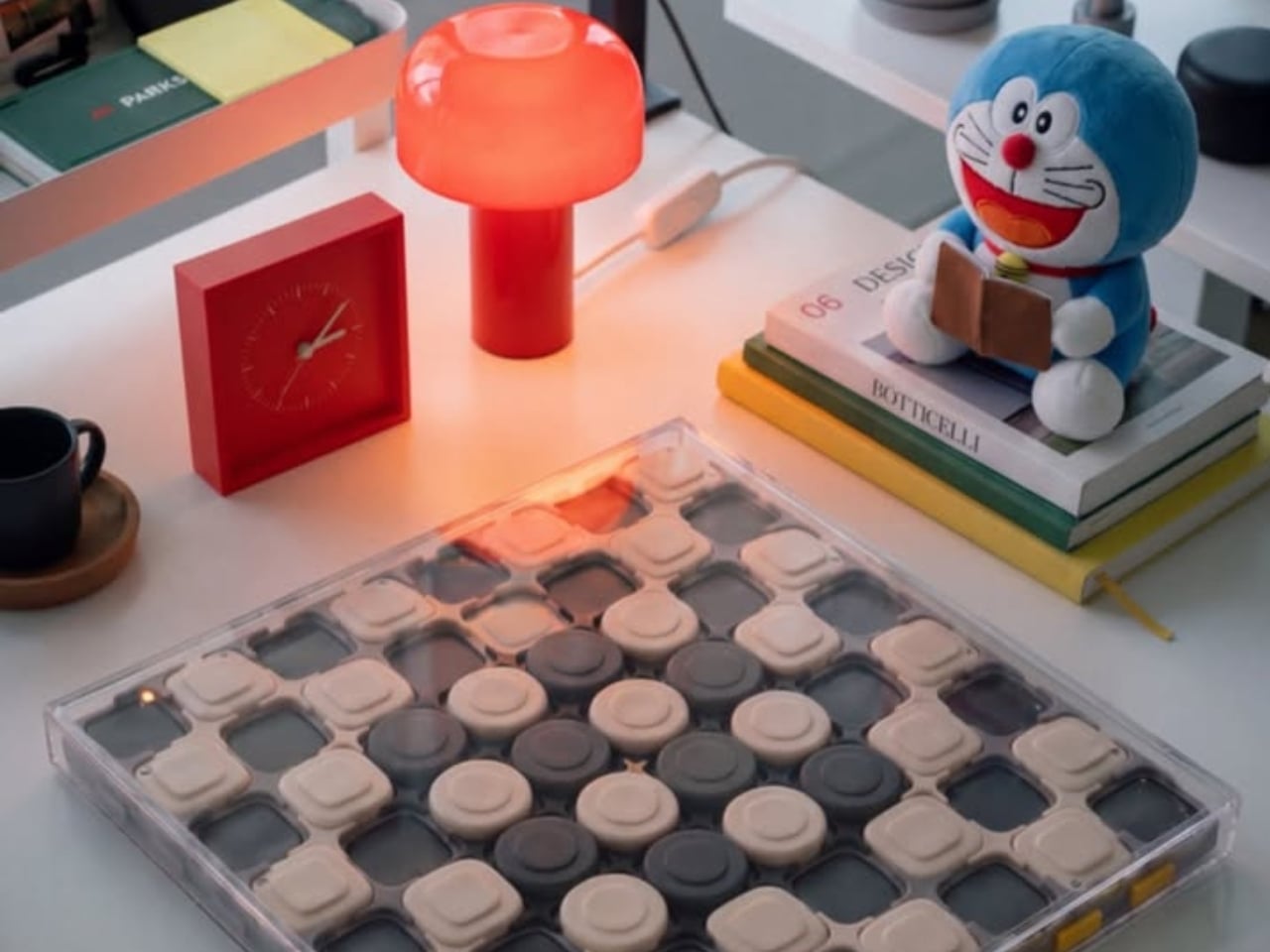
Underneath those shells sits an eight-by-eight grid of black and pale peach forms with rounded corners and raised surfaces, almost like an oversized keyboard. Circular details occupy the middle area while square forms dominate elsewhere, and small orange accents interrupt the palette. The images don't establish what those components do mechanically, so I wouldn't call them buttons or switches. Visually, though, they give the board depth and rhythm that a printed checkerboard lacks. The clear enclosure makes those layers visible rather than hiding them behind a finished exterior, which is the design's whole philosophy: show the work, don't conceal it. The packaging carries the same attitude, with oversized yellow lettering, blue corner accents, and diagrams of the layered board. The shell package explicitly labels itself as a set of four, making the customization idea legible before anything is opened. That clarity is rare, and it earns the design real credit.
Here's the takeaway worth circling back to: CHEKT is a concept that asks the right questions, but the answers are still unverified. I'd want to know how the shells attach, how easily their surfaces scratch, and whether the added graphics complicate play. Those answers determine whether CHEKT feels practical rather than merely photogenic. If the shells click on securely and wipe clean without smudging, this is a board that earns its place on a desk beside an orange mushroom lamp. If they don't, it's a nice render that disappears when you're not paying attention. Watch for the attachment mechanism. That's the razor clam hiding in the spec sheet. Everything else is just decoration.