
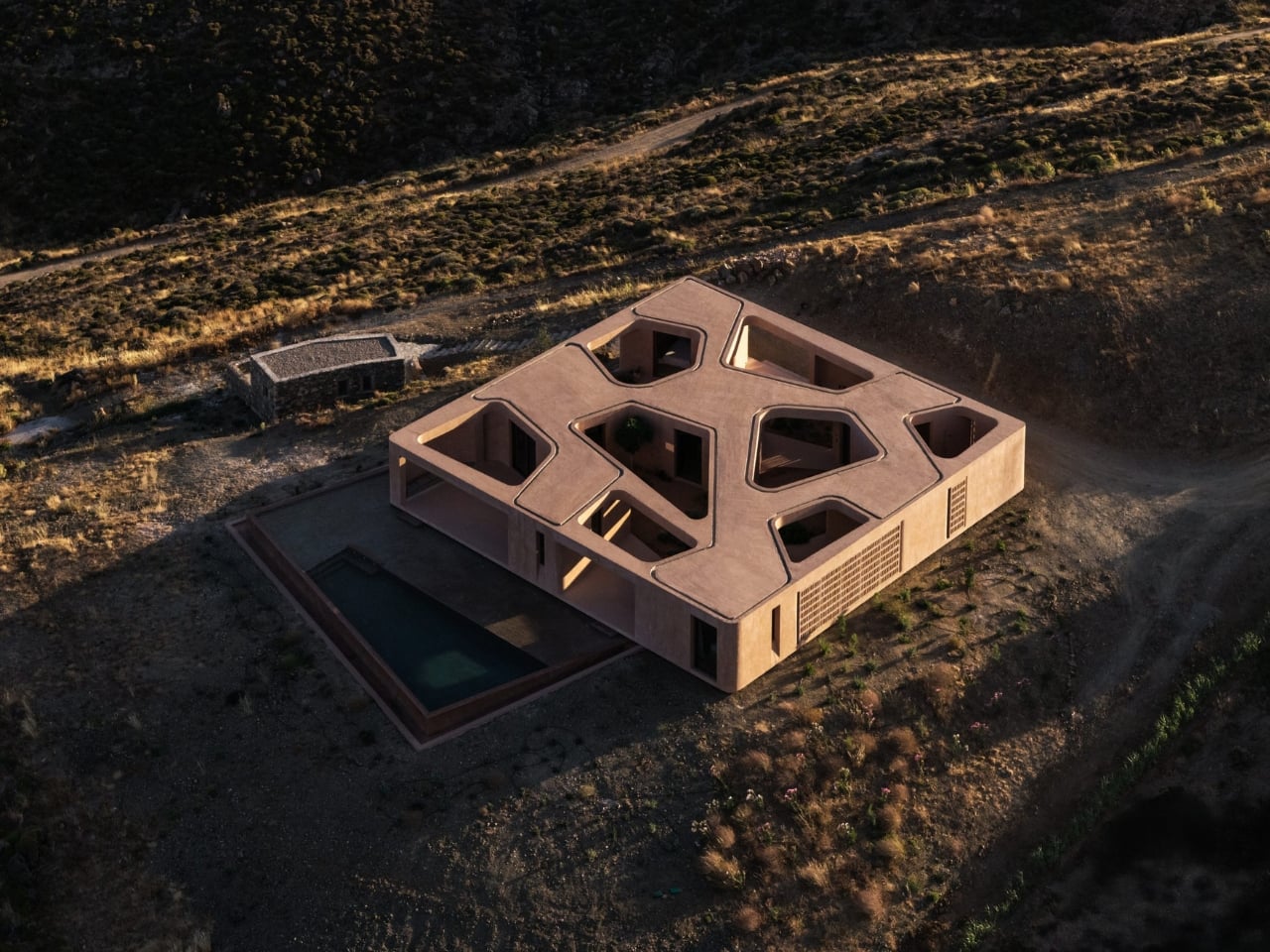
This pink house on Serifos doesn't just sit on the landscape, it hollows itself out and grows gardens in the cavities. MOLD Architects sliced seven irregular courtyards into the roof of the M Residence, turning what could have been a solid terracotta block into something that breathes from the inside. The aerial view is the hook, but the real work happens at ground level, where those openings solve a problem most scenic homes get wrong: how to feel connected to the outdoors without living in a fishbowl. We've seen plenty of houses that throw a wall of glass at the sea and call it a day, and plenty more that seal themselves off for privacy. This one carves out a middle path, giving rooms their own sheltered patches of sky and planting while keeping the enclosing walls intact. It's the kind of architectural thinking that rewards the second look, and the kind of project we'd normally cover alongside tiny homes or indie launches that rethink a familiar problem from an unexpected angle.
The pink plaster is the detail that nearly steals the show. Against Serifos's dry, rocky terrain, that warm earthy tone reads less like a vacation brochure and more like something that grew there. White walls would have bounced the light into a glare; this color soaks it up and gives the shadows under the roof edges a richness that photographs well but feels even better in person. The curved walls borrow from local monasteries and village cubic forms, but the architects also pulled from rural dry-stone structures, which explains why the house never feels precious despite its sculptural ambition. Iliana Kerestetzi first drew this design in 2011, and it sat unbuilt for over a decade before new owners revived it. That delay turned out to be a gift, the studio revisited the scheme, opened the rooms more generously toward the courtyards, and warmed the material palette. A drawing can have a strong identity and still need a decade of living before it becomes somebody's actual home.
The courtyards do the heavy lifting, but the kitchen counter facing the water is the detail that makes me want to know who lives here. That broad window and the stools tucked beneath it treat the Aegean as a backdrop for an ordinary morning coffee, not a spectacle reserved for the living room. It's a small move, and it tells you more about how the house works than any aerial shot can. What I really want to know is how those seven courtyards perform through a Greek summer, whether the shade holds, whether the planting survives August, whether the residents end up using all of them or gravitate to one or two. The photographs show sheltered corners and generous openings, but they don't show the wind patterns or the afternoon heat. I'm not going to pretend this arrangement is a passive cooling system without evidence. What I can say is that the residents have already made one adjustment the studio didn't specify: they hung white fabric beneath one roof opening to soften the light. That's the detail that matters most. A house this carefully composed could easily feel too precious to touch, and here the occupants have already made it their own. The pink walls and curved openings will carry the photographs, but a piece of fabric tells you someone is making a home.