Rare WWII Japanese Fighter Raised From Seabed Off Kagoshima 81 Years After Combat Loss
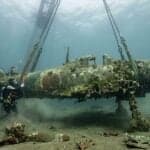


A rare World War II fighter aircraft used by the Imperial Japanese Navy has been brought back to the surface more than 80 years after it crashed into the sea off Kagoshima Prefecture.
The aircraft, a Kawanishi N1K2-J Shiden-Kai, was recovered on April 8 from shallow waters about 200 metres offshore near Akune City. It had been lying at a depth of around three metres since April 1945, when it was forced into the sea during combat.
The recovery was carried out by a local heritage group using a crane mounted on a barge. Workers first lifted smaller parts, including the propeller, before raising the main fuselage and wings.
The entire process took about three hours and was watched by more than 100 people, including residents and project members.
Despite spending decades underwater, much of the aircraft remained in place. The wings were still attached and stretched out, giving it the clear shape of a fighter plane, although the rear section of the fuselage was missing.
The condition of the structure was better than expected after so many years in seawater. The aircraft had long been known to locals, as it lay in shallow water and could sometimes be seen on clear days.
Historical accounts say the plane was flown by Lieutenant Yoshishige Hayashi. On April 21, 1945, he took off to intercept US B-29 bombers. He managed to shoot down one bomber before being forced to ditch the aircraft at sea. People nearby rushed to help, but he had already died.
The recovery project was led by a local preservation group headed by historian Eisuke Himoto, who has studied the pilot’s life and spoken to people familiar with the incident. He had also organised a memorial service in Hayashi’s honour.
Before the operation, a diving survey confirmed that key parts of the aircraft, including the cockpit and wings, were still intact. A crowdfunding campaign held last year raised about 2.4 million yen to support the effort.
The team had originally planned to recover the aircraft during the 80th anniversary of the end of the war, but the operation was delayed.
The Shiden-Kai, known to Allied forces as “George”, was one of Japan’s most advanced fighters in the later stages of the war. It was developed from an earlier floatplane design and had strong armament and good manoeuvrability.
The aircraft was powered by an 18-cylinder Nakajima Homare engine producing around 2,000 horsepower and was equipped with multiple machine guns and 20mm cannons.
Although it was capable in combat, its impact was limited due to late production, shortages of materials and damage to factories caused by bombing. Only a limited number were built before the war ended.
Very few Shiden-Kai aircraft exist today. The recovered plane is expected to become one of the rare surviving examples in Japan.
After being lifted from the seabed, the aircraft has been placed on a barge and will be moved to a port for conservation. The process will involve removing salt from the structure over an extended period to prevent further damage.
Once restoration work is completed, the group plans to display the aircraft as a historical artefact.
References: interestingengineering, asahi
Want to read more?
Check out the full article on the original site