Royal Navy Deploys £500M Autonomous ‘Adventure’ Minehunter To Detect And Destroy Naval Mines
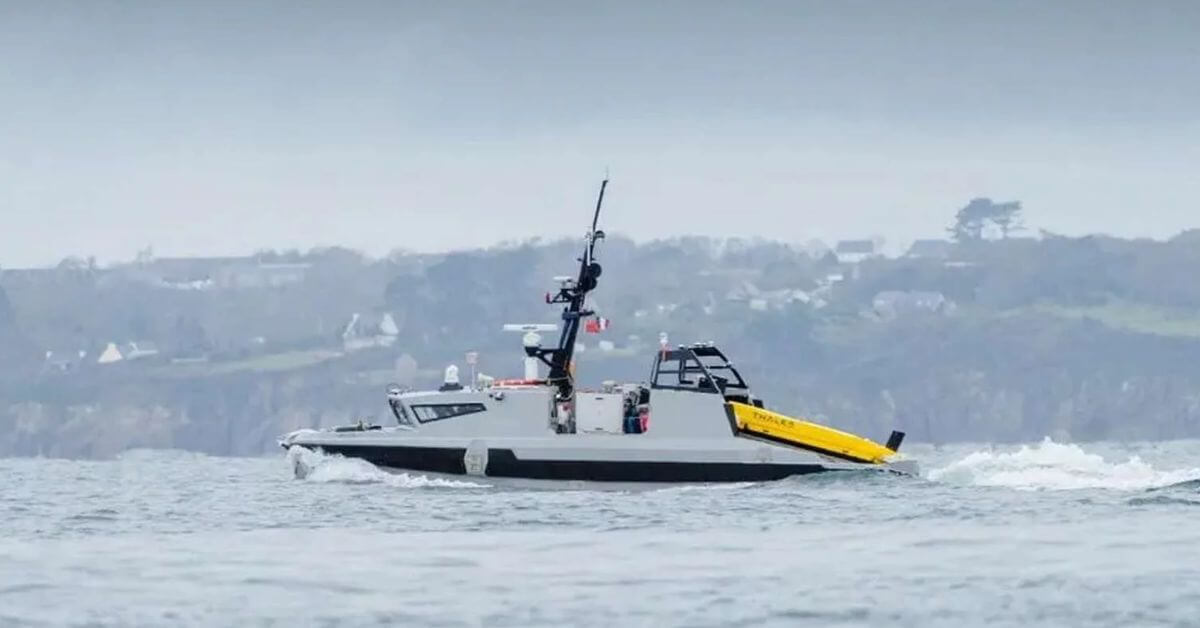
The Royal Navy has taken delivery of a new uncrewed minehunting system called Adventure, as part of a joint UK-France programme aimed at modernising naval mine warfare.
The system was delivered on 3 April 2026 in Plymouth under a €430 million (about $500 million) project led by Thales, with the UK contributing around £184 million.
Adventure is a 12-metre uncrewed surface vessel designed to carry out mine countermeasure operations without putting crew at risk.
Instead of relying on traditional mine countermeasure ships, the Royal Navy is shifting towards remotely operated systems that can be controlled from shore or from a host vessel.
The system is not just a single drone but works as the main platform in a wider setup. It deploys and manages multiple off-board systems, allowing operators to complete the entire mine-clearing process, from searching and identifying to neutralising mines, while staying away from dangerous areas.
Adventure is the second system delivered under the programme, following Ariadne, and is one of four planned units that will form the Royal Navy’s initial minehunting capability under this project.
A key part of the system is its sonar. It uses Thales’ Towed Synthetic Aperture Multiview sonar, which produces detailed images of the seabed.
The sonar captures several views of a target in a single pass, helping improve accuracy and reduce confusion during detection. The system also uses AI-based tools to process sonar data quickly and highlight possible threats, reducing the workload for operators.
The platform can also deploy additional underwater vehicles such as the SeaCat system. This hybrid vehicle supports both large-area scanning and close inspection of objects.
It can operate for long durations, dive to significant depths, and switch between autonomous and tethered modes depending on the task.
For neutralising mines, Adventure uses Saab’s Double Eagle remotely operated vehicle. This system carries explosive charges that can be placed directly on identified mines.
It can operate at depths of up to 300 metres and is capable of dealing with multiple mines in a single mission, which helps speed up operations and reduces the need for repeated deployments.
The system is designed to operate in moderate sea conditions, making it suitable for real-world missions near ports and busy shipping routes.
The Royal Navy plans to use it in different roles, with HMS Stirling Castle supporting operations in UK waters and RFA Cardigan Bay expected to act as a forward base in the Gulf region.
Naval mines continue to pose a serious risk to shipping and naval operations, as they can disrupt key maritime routes and infrastructure.
By introducing autonomous minehunting systems like Adventure, the Royal Navy aims to maintain access to important sea lanes while reducing risks to personnel.
The programme also supports NATO requirements for securing maritime approaches. It reflects a wider shift towards modular and remotely operated systems that can be adapted for different missions.
If successful, the system could lead to further deployments and wider adoption of similar technology in the future.
References: interestingengineering, armyrecognition
Want to read more?
Check out the full article on the original site