UW and Microsoft expand relationship to enhance AI learning and research with aim to prepare Washington’s workforce for the future
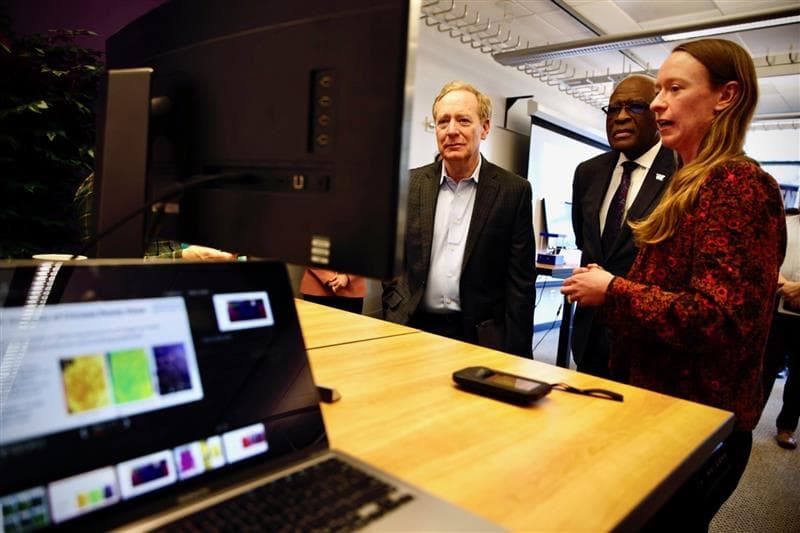

The University of Washington and Microsoft have announced the expansion of their long‑standing partnership uniting world-class academic research with world-leading technology. UW and Microsoft aim to accelerate AI discovery, prepare students and workers for an AI-driven economy, and help communities understand and use AI responsibly.
The announcement, made today by UW President Robert J. Jones and Microsoft Vice Chair and President Brad Smith during an event at the UW’s Paul G. Allen School of Computer Science & Engineering, will increase the University’s access to the most advanced AI computing power, expand internship and applied research opportunities for its students, and develop community AI literacy programs, including a foundational AI course for working Washingtonians.
“Our long-standing partnership with Microsoft demonstrates what’s possible when universities and industry come together to support students and our society, and we are grateful for their continued support,” Jones said. “Together, we’re expanding students’ access to hands-on learning, advancing AI research and strengthening our workforce.”
This announcement builds on Microsoft’s decades-long support of the University, including $165 million of investments in student scholarships and enhancements to the UW’s world-leading computer science and engineering programs. In tandem with ongoing state and federal support, these investments have helped increase access to education and contributed to the state’s highly skilled workforce.
“President Jones has outlined a bold vision for the University of Washington, one that expands access and affordability in higher ed, forges radical partnerships and strengthens civic health,” Smith said. “It’s essential that this vision includes broad access to AI technology and the skills to use it, so students, workers and communities across Washington are prepared for this new era of computing and can share fully in its benefits.”
The timing of the announcement comes as forecasts predict a need to fill 1.5 million job vacancies in Washington by 2032 — about 640,000 new jobs and 910,000 openings due to retirements, according to Partnership for Learning. Up to 75% of those vacancies will require post-secondary credentials, with four-year and advanced degrees in highest demand. If current trends hold, experts predict a shortfall of nearly 600,000 credentialed workers in Washington over the decade.
“It’s critical that industry, colleges and universities, and policy makers continue to work together to maintain the region’s economy and climate of innovation and discovery,” Smith said. “That includes avoiding going backward by making cuts to core state funding that would make a college degree less accessible to our state’s students.”
The budgets proposed by the Washington State Legislature’s majorities would keep funding for the UW largely stable. Historically, the Legislature has created a fertile environment for workforce growth and training through the Washington Workforce Education Investment Act (WEIA) and the Washington State Opportunity Scholarship (WSOS).
Since passage in 2019, with support from Microsoft and other business leaders, the WEIA has generated more than $2 billion in dedicated funding to expand higher education access in Washington. WSOS — a first-of-its-kind public-private partnership in which private employers contribute philanthropic dollars that are matched by the State of Washington to expand access to higher education in high-demand fields — has delivered nearly $150 million in total scholarships statewide, combining private donations and state matching funds. One-third of WSOS scholars attend the UW.
“These new elements of our partnership with Microsoft continue to position the UW and our state as leaders in access to higher education and at the forefront of the emerging technologies that can drive broad-based prosperity,” Jones said.
Microsoft and the UW’s expanded partnership will:
- Provide faculty, researchers and students with access to advanced computing capabilities that enable modern AI training, experimentation and research, and instruction. Microsoft is supplementing this effort by donating Microsoft Azure cloud computing credits to help accelerate the development of a research cloud computing platform.
- Launch a new initiative to connect UW faculty, visiting professors and students with real-world research opportunities at Microsoft. This is based on a new “research marketplace” that will be established and supported by Microsoft’s AI for Good Lab. It will be complemented by 10 additional graduate student-researcher slots per year — eight through the Microsoft Research organization and two in the AI for Good Lab.
- Support undergraduate students as they become civic leaders, helping them build ethical judgment, digital citizenship and agency to co-design how emerging technologies, including AI, will serve communities and democracy.
- Join forces with UW’s Continuum College, an institution serving more than 50,000 learners annually through 400 programs serving young people, working adults and senior citizens. The UW and Microsoft will develop programming that helps Washingtonians navigate AI-related workforce transitions with confidence and purpose. This collaboration will result in new courses and other learning pathways focused on career resilience, evolving job demands and navigating the challenges that accompany shifting career identities.
- Beginning this fall, the UW and Microsoft will launch a new collaboration on Microsoft’s Redmond campus that reimagines how universities and industry work together. This part of the work will deepen workforce‑connected education and applied learning. The collaboration will support the co‑development of select courses and learning experiences for Microsoft employees navigating rapid AI‑driven change, while enabling UW students to learn alongside industry professionals and gain real‑world insight as part of their academic experience. Additional details will be announced later this year.
Since becoming the UW’s 34th president in August 2025, President Jones has set out three key priorities for the University: increasing access to education, including through the goal of making a UW degree debt-free for Washington undergraduates; spurring radical collaborations with businesses and communities to advance positive change; and eliminating any artificial barriers between the University and the communities it serves.
Along with strategic planning underway at the UW, Jones is engaging with corporate and civic leaders, as well as organizations throughout the region, to expand existing partnerships with the UW. Through these relationships, he aims to support access and affordability for students and the economic vitality and social fabric of Washington state and beyond.
For more information, contact Victor Balta at balta@uw.edu.
Want to read more?
Check out the full article on the original site