
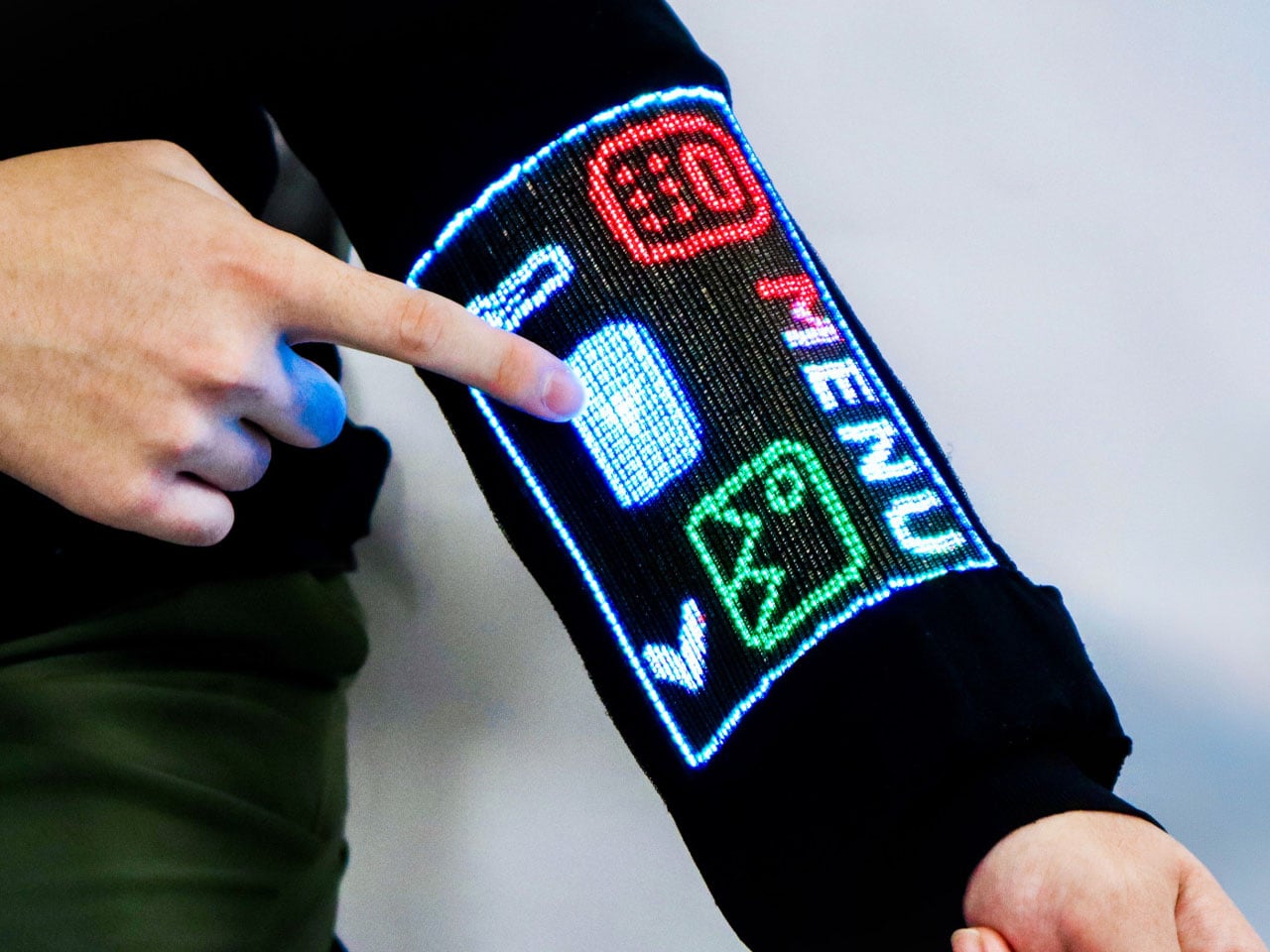
There's something deeply satisfying about a piece of tech that doesn't try to look like tech, and the sleeve-touchscreen from the National University of Singapore is exactly that kind of quiet subversion. It's not a screen sewn onto fabric; it's a fabric that *became* a screen, with 54 specialized fibers doing the work of pixels and touch sensors simultaneously. That distinction matters, because it means the thing you're wearing stays a piece of clothing first, flexible, breathable, machine-washable, and only becomes a display when you need it to. This is the kind of thinking that makes you wonder why we've spent decades strapping rigid glass rectangles to our bodies when the entire history of human dress has already solved for comfort and movement. It's also the kind of thinking that pairs beautifully with something like CMF’s milk-carton speakers make minimalism look deliciously loud, where the object disappears into its own design language, or The bracelet that ghosts your notifications without a single screen, which argues that maybe the best wearable is the one that doesn't demand your attention at all. The NUS sleeve exists in a fascinating tension between those two impulses: it's both more visible and more invisible than what came before.
The practical specifics are what make this worth watching. The display is low-resolution, 96 x 54 pixels, so you're not streaming *Dune* on your cuff. But that's almost the point. A low-res fabric screen that survives 50 machine washes and a thousand bends is a screen that can live where high-res plastic cannot: on a firefighter's sleeve showing body temperature, on a runner's arm displaying heart rate, on a caretaker's wrist flashing a patient's vitals without anyone having to pull out a phone. Assistant Professor Tural Khudiyev and his team built the GUI from electronic fibers that function like yarn, which means the garment breathes and flexes like normal clothing. That is not a small thing. Every previous attempt at tech-infused clothing has felt like a compromise, stiff panels, awkward battery bumps, the constant worry about the washing machine. This one shrugs off those concerns with actual data, and that makes it feel less like a concept and more like a foundation.
What we don't know yet, and what Spoot is obligated to wonder aloud about, is whether this foundation will actually get built into something you can buy. The team hasn't announced a release date, and the Nature paper, published October 2026, describes a prototype sleeve, not a product. The path from a lab demonstration to a garment you can order online is long and littered with failed crowdfunding campaigns and press releases that never became deliveries. But here's the detail that keeps me circling back: the touch-sensitive layer can pair with Bluetooth devices and respond to voice commands. That means it doesn't have to replace your phone; it just has to talk to it. That's a much lower bar for usefulness, and a much smarter way to enter the world. The specific question to watch is not whether the resolution improves, it will, but whether anyone is willing to manufacture the fibers at scale, in a color you'd actually wear, at a price that doesn't make you flinch. That's the razor clam in this spec sheet, and it's the only thing standing between a clever sleeve and a genuine shift in how we wear our technology.