
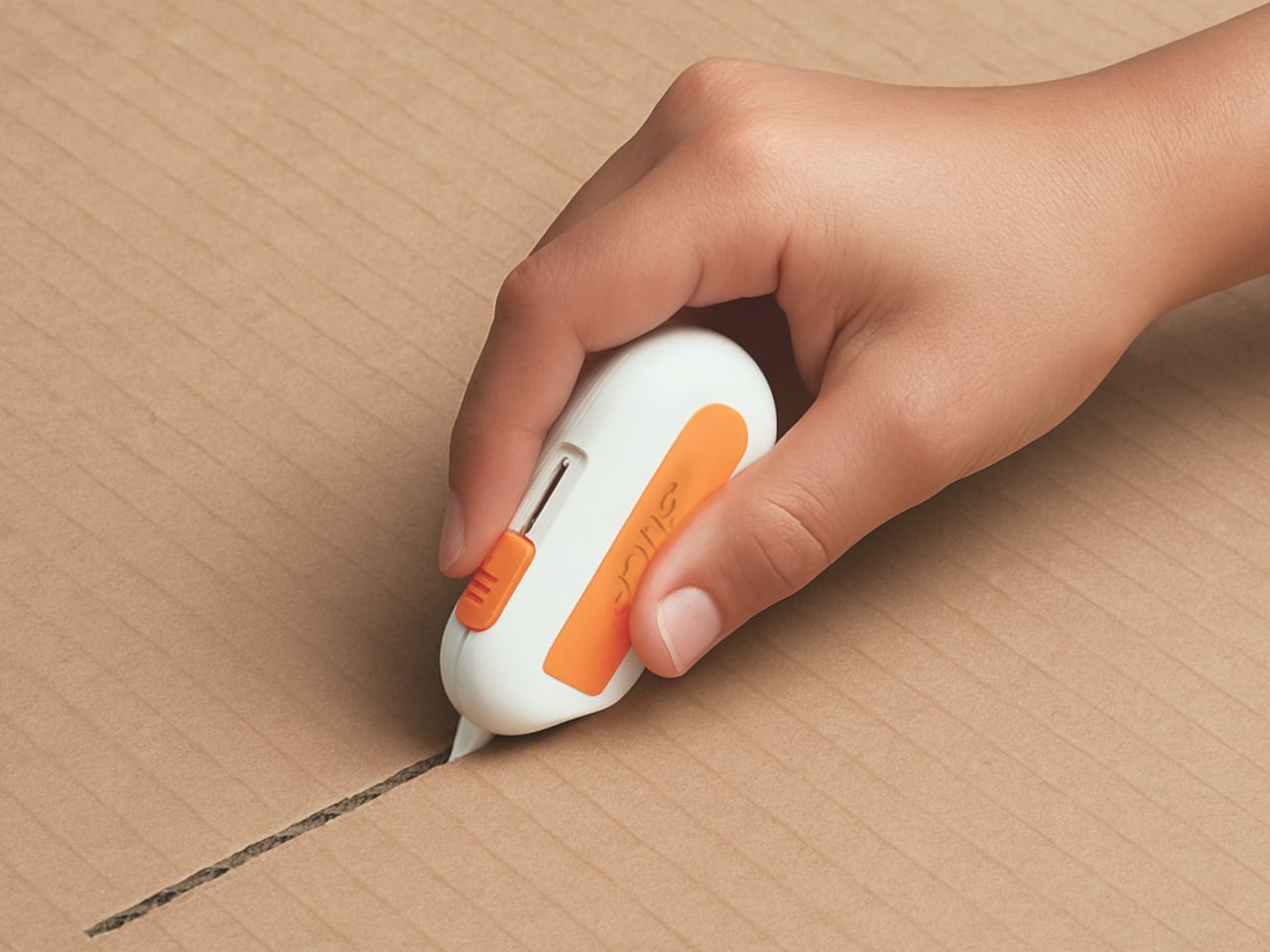
There's a particular moment in every cardboard-box project where an adult quietly takes the knife away, and the kid learns that the sharpest thing in the room isn't the blade, it's the moment your hand gets told it isn't ready. The Kids Cutter concept doesn't just propose a smaller handle for smaller hands. It asks a sharper question: what if we redesigned the tool instead of training the child to accommodate the adult one? That's the kind of sideways thinking that makes us pay attention, even if the prototype still has blade locks to fix and a slider that needs better feedback before it belongs in a classroom drawer.
The geometry is the real news here. A broad, rounded shell with an angled bottom that rests against the material, a grip that wraps around the body instead of hovering above the cut, this isn't a scaled-down X-Acto. It's a different hold entirely, one that positions the hand close to the cutting surface and reduces the sideways slip that sends a blade veering off course. Jorge Enrique Reyes Flandes worked through six design versions and foam models before arriving at this shape, and you can feel the difference between a form that was sketched and one that was held. That matters because a craft knife for ages seven to twelve has to work for a seven-year-old's grip and a twelve-year-old's, which are not the same thing. It's a similar instinct to what we saw in A Phone That Lets Kids Bike Away and Parents Breathe, a product that rethinks a tool's relationship to the kid using it, rather than just wrapping adult technology in a pastel shell and calling it child-friendly.
But here's where Spoot's ears perk up and start twitching. The concept draws on Slice's ceramic blade technology, and Slice's own documentation acknowledges that ceramic still cuts skin. The blade geometry reduces injury risk, but "reduces" is not "eliminates," and a tool designed for children needs more than a reassuring material choice to earn its place in a supply closet. The prototype's blade lock and slider feedback are explicitly flagged as areas needing improvement, not finished solutions. This is a student concept, not a shipping product, and we should say that plainly, the same way we stared at Samsung's SmartTag3 battery for 790 days and refused to blink at its claimed lifespan without wondering what happens on day 791. Specs are promises, and promises need pressure testing.
What we'd watch next is the blade-changing process. A tool that lets kids cut their own cardboard but requires an adult to swap the blade is a tool that still hands the scissors back to the grownup at the worst moment. The concept has a ridged slider that controls the blade extension, keeping the cutting end short and close to the supporting base, that's smart, that's the kind of narrow detail that makes a difference in practice, but the real test is whether a kid can reload it without learning a new vocabulary word for why they shouldn't. Until that mechanism feels as considered as the grip, the Kids Cutter remains a very good idea waiting for its second act. We're rooting for it. We're also keeping the blade lock open as a question.