
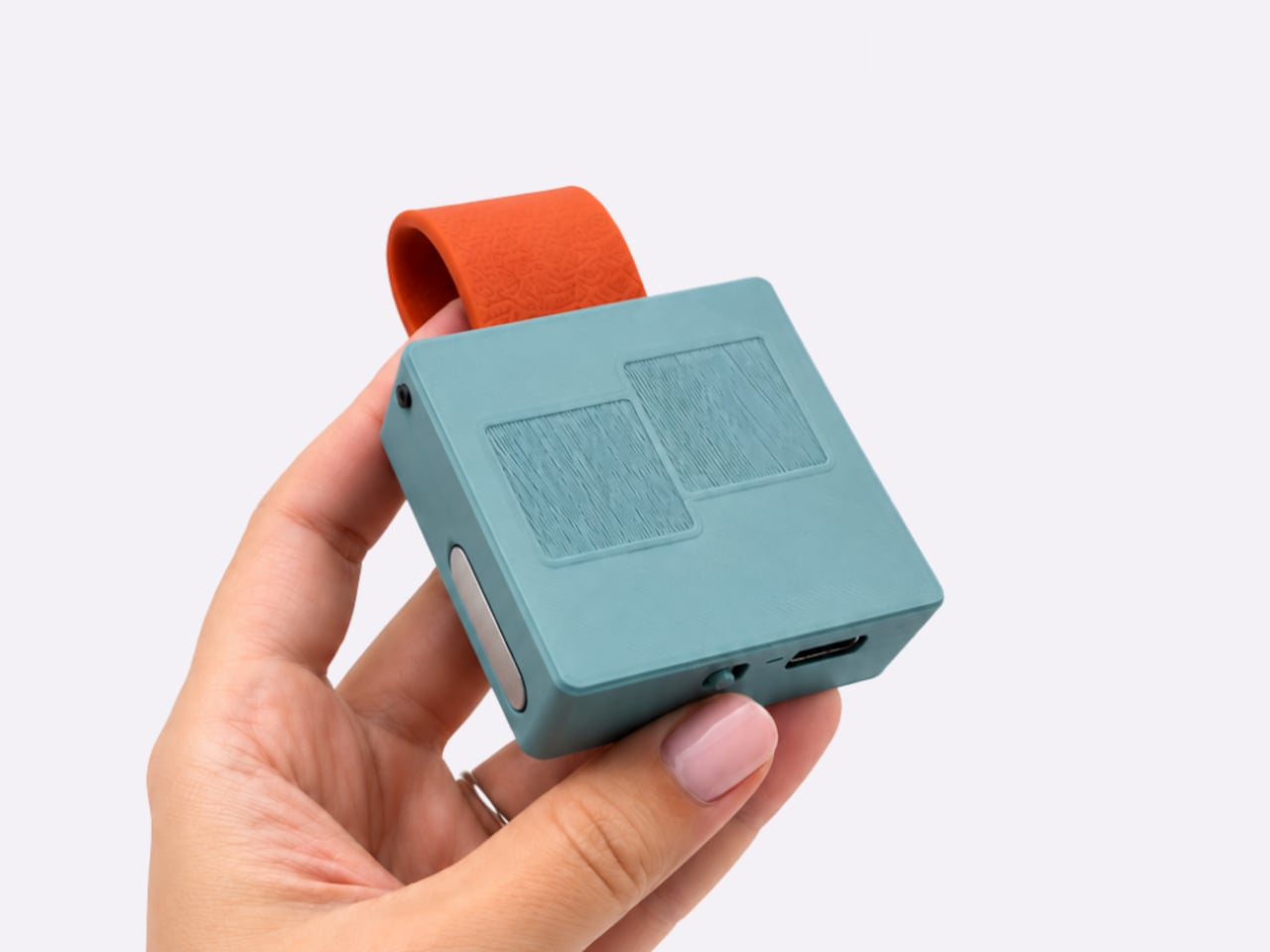
TypAir straps a keyboard to your wrist so you can type without talking, and honestly, we're not sure whether to be delighted or skeptical, which is exactly the right place to start. This is a wearable Bluetooth keyboard prototype from MindRove that attaches magnetically to your clothing, translating finger gestures into characters so you can compose text without speaking aloud or pulling out a phone. It's the kind of detail-first idea that burrows into a narrow problem, the moment when you're wearing smart glasses and need to reply without announcing your message to the room, and asks whether a tiny gesture-based surface worn at your hip can replace the muscle memory of decades spent pounding actual keys. We've seen wearables try to solve adjacent problems before. Arc's bracelet whispers a tug-of-war with your thumb nudged you away from screens entirely, and The bracelet that ghosts your notifications without a single screen proved that sometimes the best interaction is no interaction at all. TypAir takes the opposite lane: it adds an interaction, one that demands you learn an entirely new alphabet before it becomes useful.
That learning curve is the razor clam in this spec sheet. TypAir assigns letters to specific finger gestures, a tap in the bottom-left corner means A, for example, and MindRove says you'll be able to customize gestures for symbols, shortcuts, and commands. The small footprint is the trade-off: you don't need a table, but you do need to memorize a gesture vocabulary before your brain stops fumbling for a Q key that isn't there. The company also plans customizable shortcuts for repeated instructions, which could make the device genuinely useful for someone entering the same command dozens of times a day. But for the person who just wants to reply "be there in five" without speaking it aloud, the alphabet has to become as automatic as the one your fingers already know. That's a steep ask, and MindRove acknowledges the prototype still needs work on gesture recognition, manufacturing, and wearable design. Six hours of battery life per charge sounds plausible for a lunch break, less so for a full workday.
The design question that keeps us circling back is placement. TypAir attaches magnetically to your clothing, pocket, or another strap, and its positioning is central to whether it feels natural or annoying. Your fingers have to find the controls without looking down, and your body has to return to the same comfortable position across different outfits, a jacket one day, a t-shirt the next. MindRove offers color options for the module and strap, which acknowledges that people might accept the function but still resent having another gadget clipped to them. That's a small but honest detail, the kind that suggests someone on the team has worn a wearable long enough to know that black-on-black is sometimes a negotiation, not a preference. Compatibility is another unfinished edge: Android and Windows are listed, iOS and macOS are under development, and the connected app is essential for setup. The whole idea collapses if your glasses don't support Bluetooth keyboard input.
The takeaway is straightforward: TypAir's value depends entirely on whether gesture recognition becomes dependable enough that you don't have to correct every third word. A quiet keyboard worn on your hip is a compelling image, but the gap between a prototype that works in a demo and a device that works in a crowded coffee shop is where most wearable keyboards have died before. Watch whether MindRove publishes real typing speed data and error rates, those numbers will tell you whether this is a clever concept or something you could actually use without muttering corrections under your breath.