
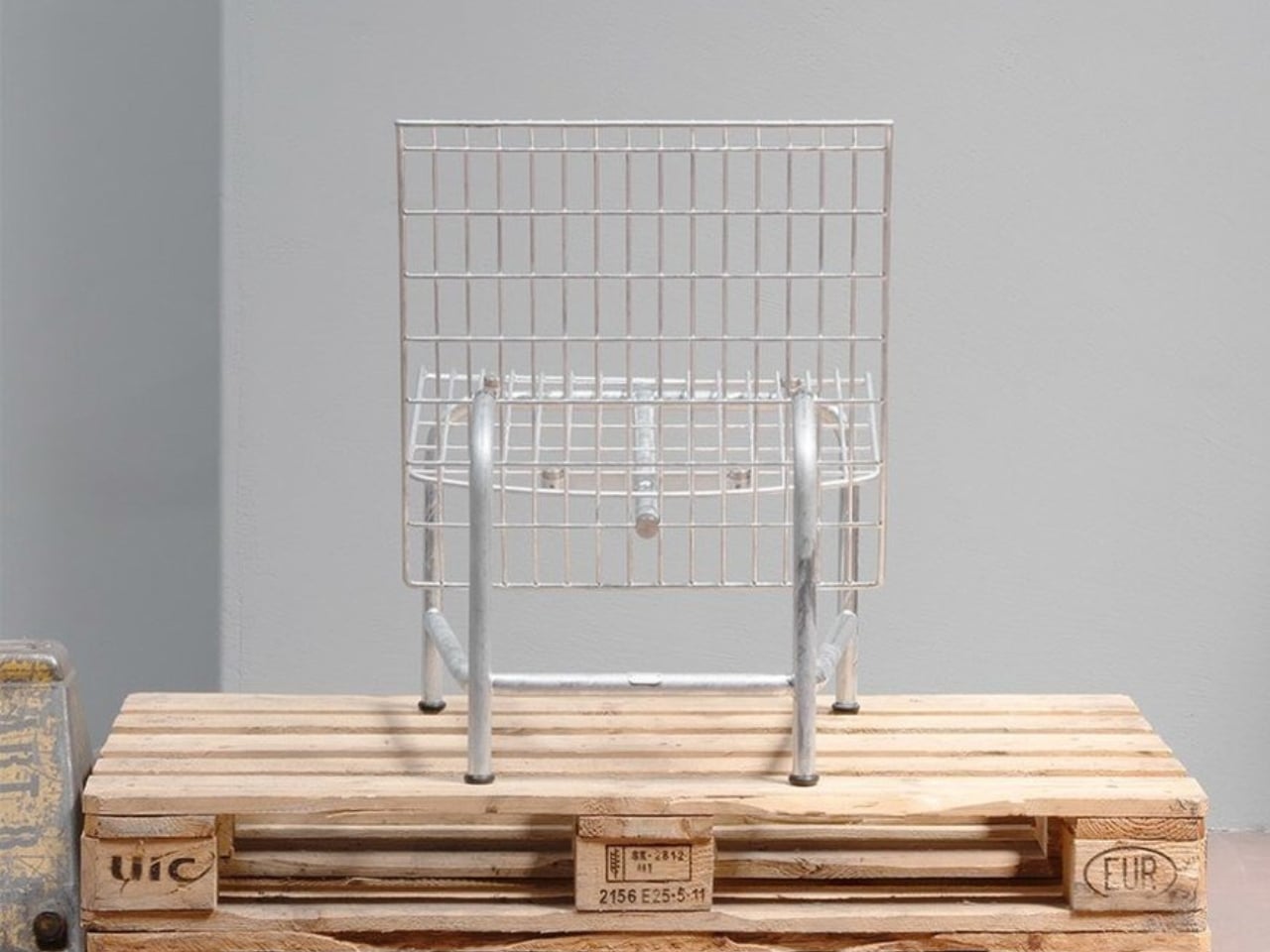
The Patio Chair from Embru and designer Moritz Schmid deserves attention for a reason that has nothing to do with how it looks, and everything to do with how it stops being a whole new problem when one part fails. That's the detail that matters: a wire-grid lounge chair where the seat swaps out without trashing the frame. It's modular in the sense that actually helps someone keep a chair for more than one season, and that puts it in a small, interesting category alongside things like The Roxon Flex Go shrinks a modular tool system without losing the weird bits and Roxon shrinks its modular Flex down to pocket-friendly size. Those tools prove modularity can survive shrinking; this chair has to prove modularity can survive a decade of weather and a broken weld.
The visible hardware helps its case. Embru's detail shot shows a circular metal fitting where the backrest meets the frame, and they left it exposed rather than hiding it under a cap or a cushion. That's a quiet vote of confidence. It says the chair was designed as an assembly of parts from the start, not retrofitted with a repair option as an afterthought. The material options reinforce the idea: an outdoor grid version and an indoor version with wood-veneer panels in oak, ash, black ash, and walnut, plus finishes that include a gray-blue grid that looks like the right balance of industrial and intentional. The wood version changes the whole visual weight, turning the backrest into a solid plane above a slender frame, which matters if you like the shape but don't want your living room to feel like a balcony.
But the unresolved question is the one you can't photograph: does it sit well? The word "lounge" carries a promise that a wire grid has to earn, and photographs can't tell you how the surface feels after an hour with a book. That's the test that separates a clever concept from a chair you actually use. Embru expects availability at the end of 2026, with no price and no US confirmation yet, and the real test of the repairability premise will come when someone needs a replacement seat and has to figure out how to order one, how much it costs, and whether it arrives before the summer ends. Designing a component to come off is the easy part. Making sure the next one gets to you without a fight is what turns a feature into a reason to buy.
I want to see the parts support follow through. I want to know whether Embru treats replacement seats like a product line or a favor. The premise earns my interest because it addresses a frustration that doesn't get enough design attention: the moment you have to throw away a perfectly good frame because the fabric ripped or the cushion rotted. The Patio Chair gives that ordinary problem a considered answer. Provided the answer actually ships, its most attractive feature may become apparent years after the first photograph, when someone's gray-blue grid is still holding up and the only thing they had to replace was the part that touched the ground.