
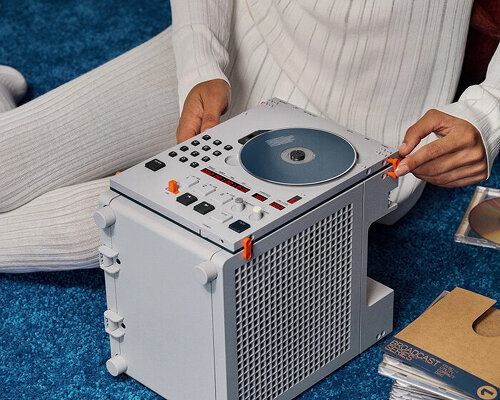
So Teenage Engineering finally made a CD player, and of course they made it weird. The EP/BC, 1 leaves the disc completely exposed, spinning in the open like a turntable for the optical age, and that alone is almost enough to make you forget how thoroughly the format was supposed to have died. But don't mistake this for nostalgia bait. The Swedish company has a long habit of pulling something genuinely fresh out of a dead medium, just look at how it treats the compact disc here. There is a varispeed dial that lets you drag playback from 50 to 150 percent of its original speed. There are cue points, beat detection, and the ability to sync external gear to whatever scratched-up copy of *OK Computer* you still own. This is not a museum piece. This is a tool. It sits in the same strange family as Kodak's new keychain is a tiny E Ink gallery for your pocket photos, both are small, deliberately physical objects that ask you to engage with media in a way the streaming world simply cannot replicate. And like that Kodak gadget, the EP/BC, 1 is more about the ritual than the resolution. You watch the disc. You touch the buttons. You hear the mechanism. It matters.
Our take is simple: this is the most interesting CD player in twenty years, and it might be the most honest one, too. Every other deck on earth hides the spinning platter behind a tray or a lid, as if the act of reading a laser across a polycarbonate disc were something to be ashamed of. Teenage Engineering says no, let the silver catch the light, let the printed label become part of the design, let the user see the thing doing the work. That philosophy extends to the controls, which borrow directly from vintage radio broadcasting desks: tactile buttons, red digital displays, an orange power switch that looks like it could launch a satellite. There is no Bluetooth pairing dance that takes three app installs. There is a keypad. You punch in a track number. The disc spins. The sound comes out. It is refreshingly, almost violently direct. The company is calling this the first entry in its Broadcast series, a family of audio gear built around older formats, and the name makes sense, this thing feels like it was designed to be operated live, on air, with someone watching.
But here is where we get the razor clam. The EP/BC, 1 ships with Bluetooth and Auracast, meaning you can send that CD signal to multiple speakers wirelessly. It docks directly onto Teenage Engineering's K.O., AMP 35 for a portable six-hour battery-powered system. It can rip tracks to USB as uncompressed WAV files. The company is not asking you to abandon convenience; it is asking you to add a layer of physical intention on top of it. That is a harder sell than it sounds. It means you have to own CDs, or be willing to buy them again. It means you have to accept that a format with a maximum of about 80 minutes per disc is somehow your new creative constraint. And it means you have to trust that a company known for making Five Designs That Cram Purple Into Places It Shouldn't Fit will actually ship this thing in reasonable quantities at a reasonable price. Teenage Engineering has a history of producing objects that are brilliant, expensive, and occasionally impossible to find. The EP/BC, 1 looks like it belongs in a studio, on a desk, in a living room, but the question nobody has answered yet is whether you will be able to buy one in 2027 without paying triple retail on a secondary market. That is the detail to watch. Not whether CDs sound better than streaming. Not whether the exposed disc will get scratched. Whether Teenage Engineering can actually make enough of them.