
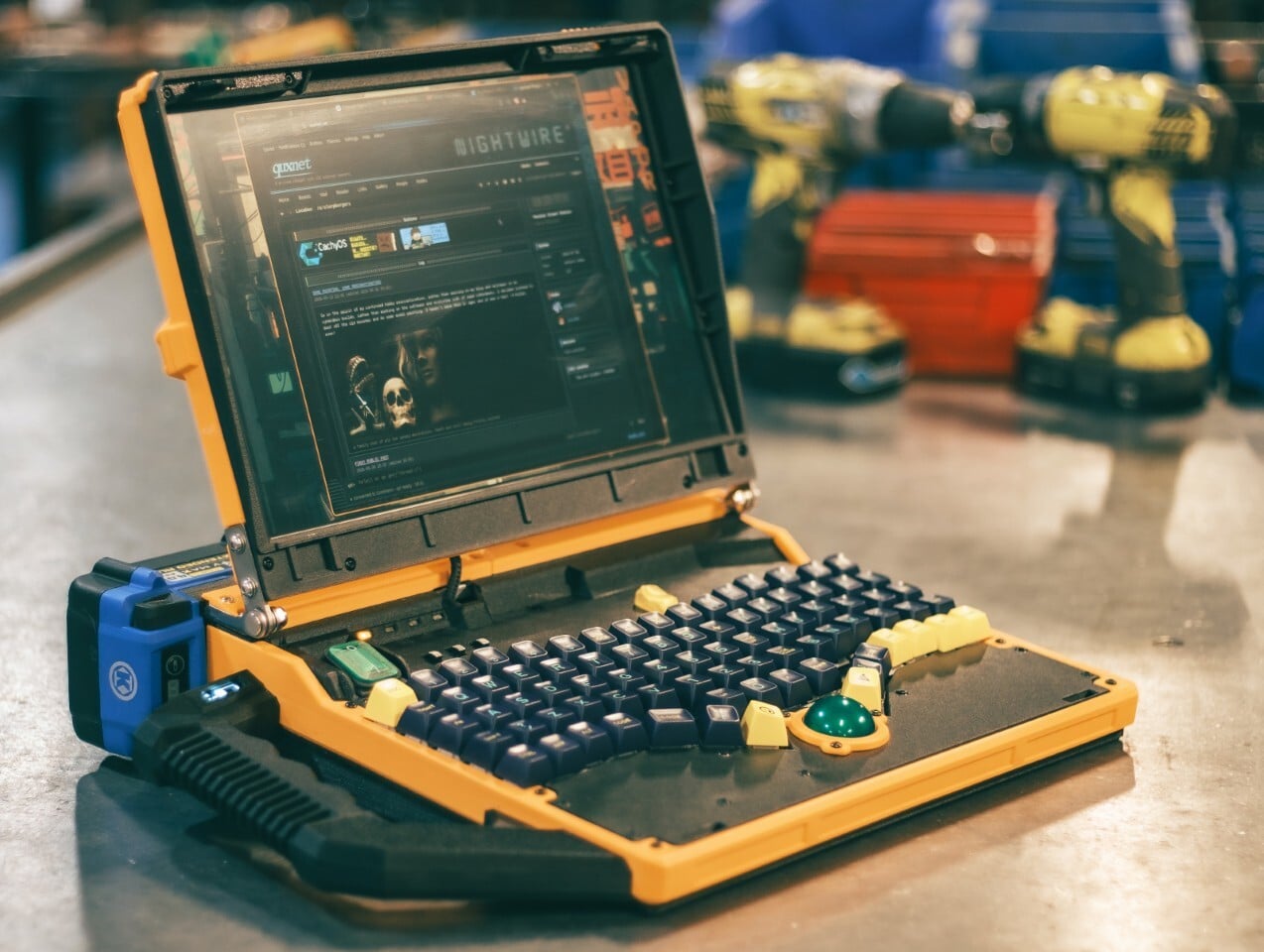
The Slurptop is the best argument against buying a laptop in 2025, and it comes from a builder who clearly got bored waiting for someone else to make the right machine. This homemade cyberdeck borrows its battery from a Kobalt tool pack and its body from a 3D printer, and the result is more honest than almost anything on a retail shelf. While Atari VCS finally closes its store, ending a decade-long death crawl, a product that spent years promising a future it could never deliver, the Slurptop just shows up with a trackball, mechanical keys, and a battery you already own. That is the difference between hype and a project that actually ships.
The power-tool styling is not a gimmick. It is the honest result of a design decision that most manufacturers would never touch: use a standard 24V battery from the hardware store and build the laptop around it. The Slurptop does not pretend to be a unibody marvel. It is a yellow-and-black clamshell made from glass-fiber-filled plastic, with carbon-fiber-filled components and an aluminum bar holding the hinge together. The handle locks into place when you assemble the housing. The battery stays external, swaps in seconds, and charges on the tool charger you probably already own. That means the laptop does not charge itself, which is the kind of trade-off a company would never admit to in a press release. The Slurptop just says it plainly: wall power runs the computer, the battery needs its own charger, and a switching module handles the transfer. Four hours of coding on a single pack is a useful number, not a marketing promise.
What makes this thing worth paying attention to is not the hardware itself, a GMKtec M5 Ultra mini PC with a Ryzen 7 and 64GB of RAM is a known quantity, but the way Slurpburgers assembled it around a real workflow. The keyboard groups its 82 mechanical keys into angled clusters, with a green trackball parked near the front center. That trackball runs on ceramic bearings over a gaming mouse sensor. You do not need desk space for a separate mouse. An XP-Pen drawing tablet tucks into a holder behind the display, so the whole setup travels together. The trade-off is obvious: you still need extra desk space to actually draw, and the whole thing weighs what it looks like it weighs. But the Slurptop never pretends to be a thin-and-light. It is a workstation that acknowledges its own bulk and uses it.
The practical takeaway for anyone reading this is simple: the Slurptop proves that the modular laptop we keep waiting for is already buildable with parts from Amazon, a 3D printer, and a trip to the hardware store. The catch is that you have to want it badly enough to assemble it yourself. There is no crowdfunding campaign, no pre-order page, no promise of shipping dates. Slurpburgers built one, documented it, and moved on. That is the razor clam in this spec sheet, the detail everyone else scrolls past is that this thing already exists, and you cannot buy it. The question is not whether the Slurptop will ship. It already did. The question is whether anyone else will bother to build their own.