
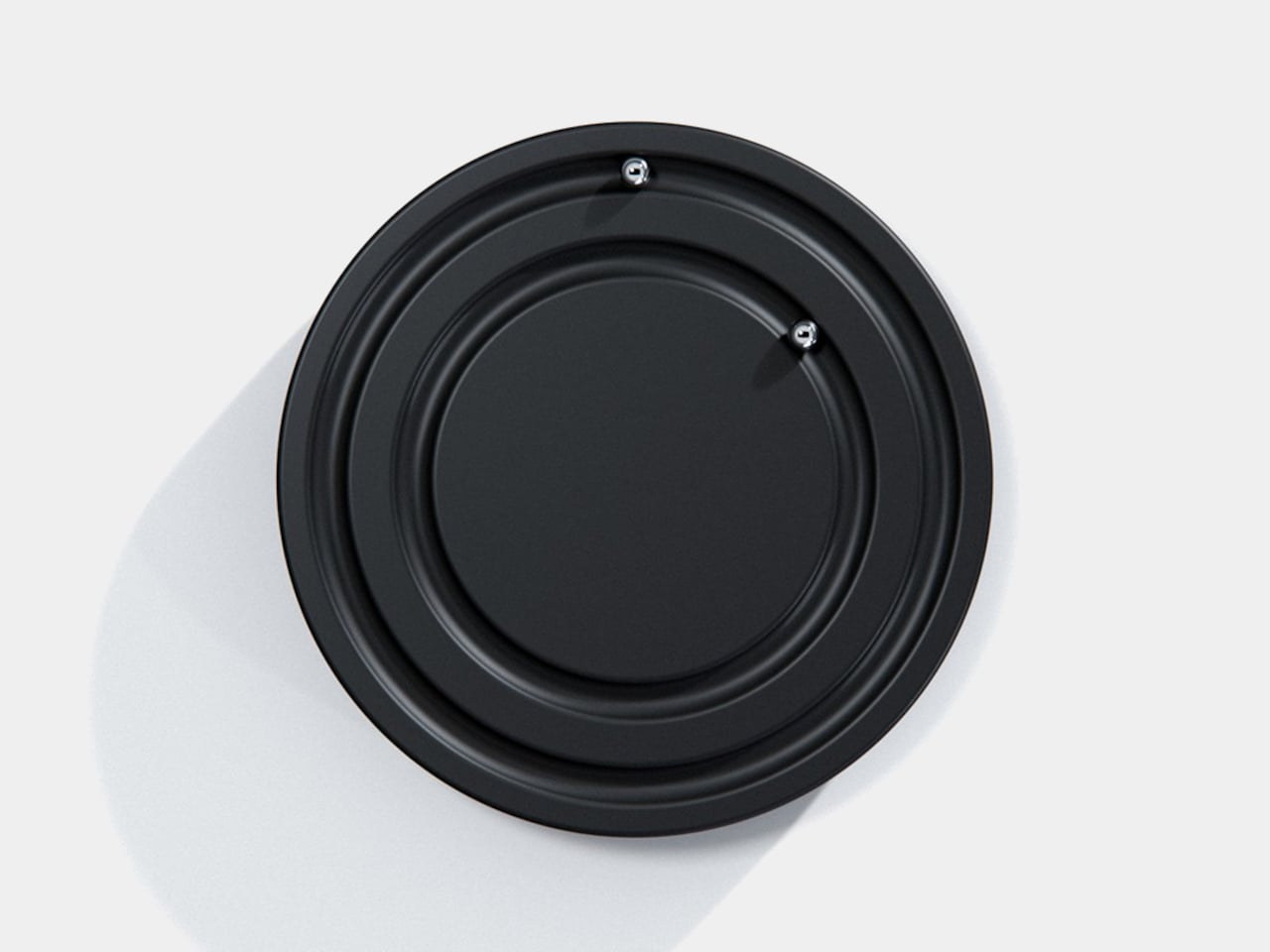
The Orbit Clock is the first time a wall clock has made me want to reach out and touch the time, and that alone earns it a spot on your wall. Designer Liam de la Bedoyere has stripped the dial down to a dark disc with two recessed tracks, then dropped a pair of polished metal spheres into those grooves. No hands, no numerals, no central pin. Just two bearings rolling around an empty center, holding the hours and minutes in place with magnets strong enough to keep them put but loose enough to let you pick them up like loose change.
This is a genuinely clever hinge in the history of timekeeping, and it works because it preserves the logic you already know. You still read positions around a circle; the hour sphere sits in its outer ring, the minute sphere in its inner one. The adjustment comes from the missing tick marks, which means estimating the hour is easy but nailing the exact minute requires a squint and a guess. For a living room glance, that is perfectly fine. For catching a train, you will still grab your phone, and the clock will not judge you for it. That compromise is honest, and we respect it more than a concept that pretends to replace your wristwatch.
What makes Orbit feel like more than a render is the tactile detail hiding just below the surface. The spheres are not trapped; you can lift them away and put them back, which turns a passive object into something you can fidget with. Remove both and the clock goes blank, a sculptural black circle with nothing to say until you return the pieces. That playful interaction is the razor clam in this spec sheet, the detail that makes you wonder whether a clock should be this fun to touch. The rear keyhole mount keeps the face flat against the wall, and the rounded edges give it a physical presence that most minimalist clocks lack.
But this is a concept, and we will say it plainly: there is no price, no release date, no guarantee it ever ships. What we are watching is the magnetic attachment. If that mechanism feels as good as it sounds, Orbit could quietly redefine what a wall clock is allowed to be. If it feels flimsy, those little spheres will end up behind the sofa and the clock will become a very expensive blank disc. The question we want answered is not whether it tells time accurately, but whether de la Bedoyere can make the act of picking up an hour feel as satisfying as the idea suggests. That is the detail to watch, and we will be refreshing his page until we find out.