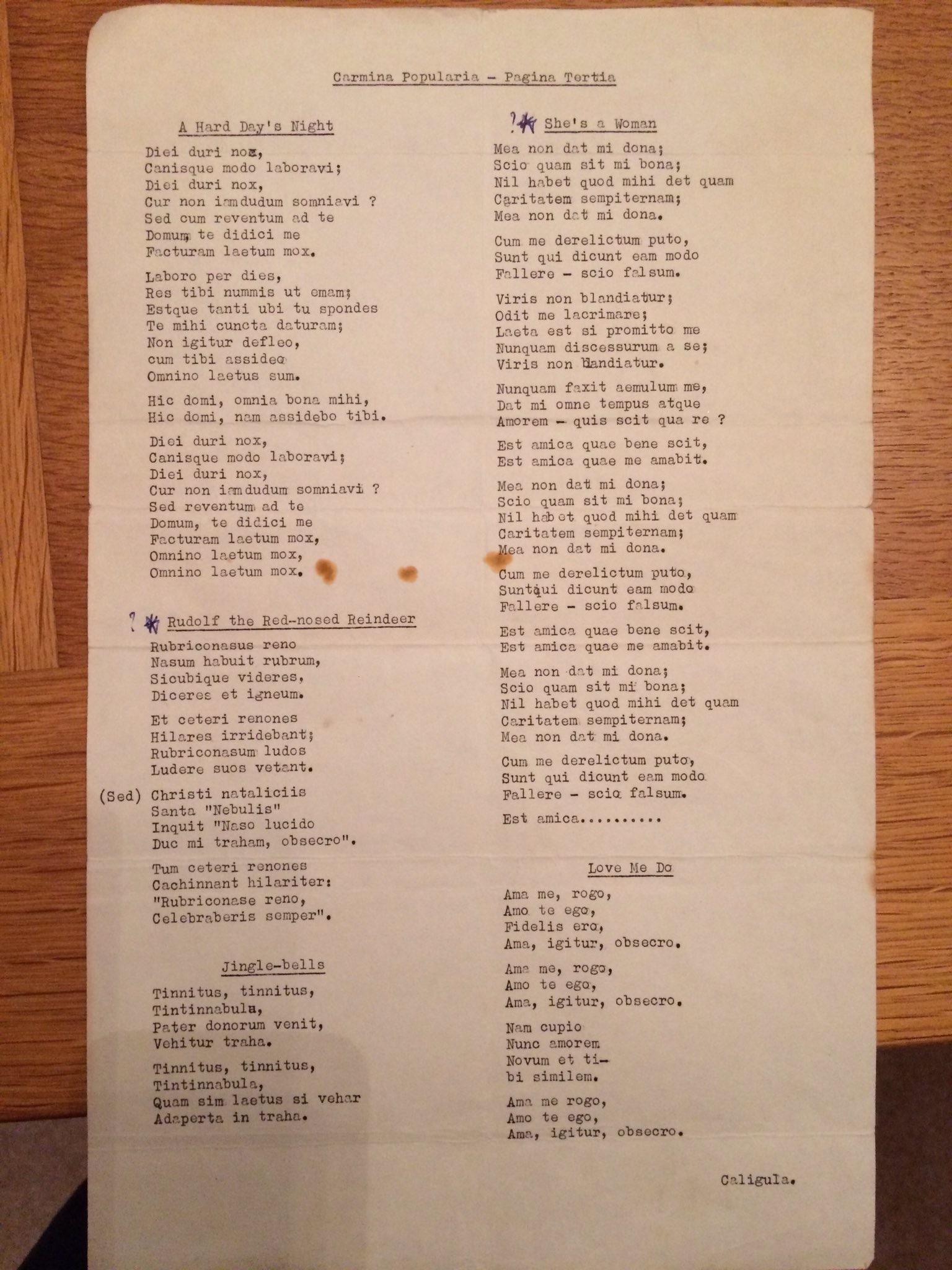
There's a specific kind of joy that comes from hearing the Beatles in a dead language, and it's not the joy of nostalgia or even the smug satisfaction of recognizing *"She Loves You"* conjugated properly. It's the joy of a trap snapping shut on your own expectations. You come for the gimmick, but you stay because, somewhere between the ablative absolutes and the iambic thump, you realize this is less about Latin and more about the sheer audacity of a teacher who looked at a classroom of bored teenagers and thought, *what if the verb tenses had a backbeat?* That's not pedagogy; that's a dare. And we at Spoot love a dare, especially when it wriggles.
The practical takeaway here isn't that you should dust off your old Wheelock's and start singing *"O Teneum Manum"* in the shower. It's that the most effective learning tools are the ones that refuse to sit still. The summary mentions the labor of counterintuitive pronunciations and the intimidation of gendered nouns, but what it doesn't say is that the labor is only unbearable when the reward is abstract. A miniseries in Spanish or a comic book in French works because it gives you a world to fall into, not a chart to memorize. Latin, with its reputation as a fossil, seems like the worst candidate for this treatment. And yet, here's a record that makes the language feel less like a museum exhibit and more like a prank call. The Beatles were already a rabbit hole; adding a declension table just makes the fall funnier.
If a reader asked us whether this actually *works*, we'd say: it depends on what you mean by work. If you mean "will you become fluent in Latin from one album," then no, and you're missing the point. If you mean "will you remember the difference between *puella* and *puellam* because you were too busy laughing at the idea of Paul McCartney singing about a beetle in iambic pentameter," then yes, absolutely. The teaching moment here is the sneak attack. You're not learning because you're trying to learn; you're learning because the material is too weird to ignore. And that's the razor clam hiding in this conversation: the best language resources don't make the unfamiliar seem easy, they make it seem worth the trouble.
So here's our honest take, wrapped in a tangent: this is a footnote that deserves to be the text. It's a reminder that education is often just a matter of finding the right hook, and sometimes that hook is a mop-top haircut and a chord progression that predates the Roman Empire. What we'd tell you, reader, is to stop looking for the perfect method and start looking for the thing that makes you laugh, or squirm, or tilt your head in confusion. Because that's the moment the language stops being a subject and starts being a thing you want to chase. And if you ever find yourself humming a Latin version of *"I Want to Hold Your Hand"* under your breath, don't fight it. That's not a dead language. That's a live wire. Stay spooty.