
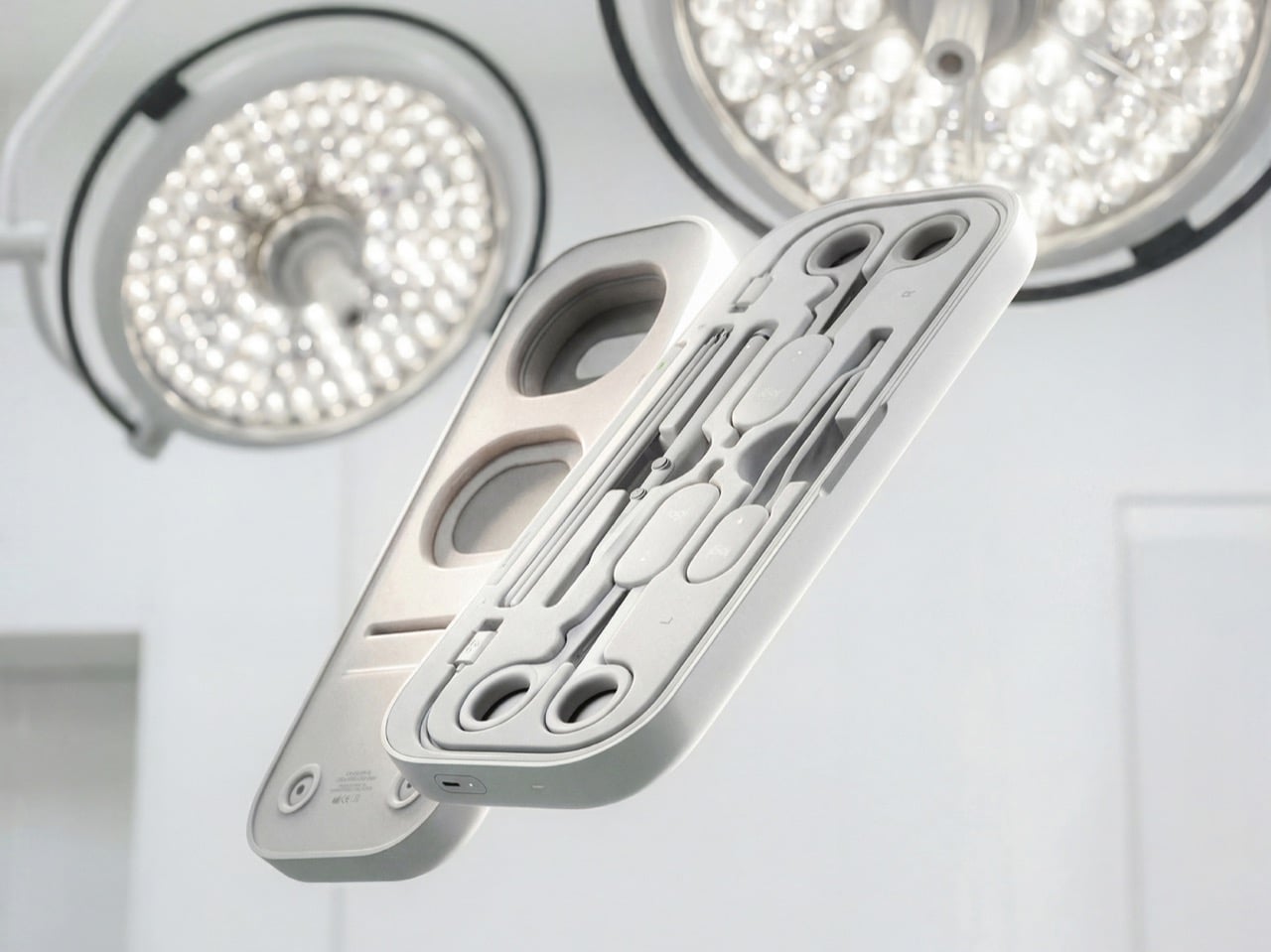
Logitech should probably just ship this thing. The MX Surgical concept is that rare kind of hardware idea that feels inevitable the second you see it, and the fact that it exists only as a prize-winning student project with no launch plans is almost frustrating. Niklas Andreasen looked at how surgeons train and spotted the same gap that lets a pilot crash a virtual 747 a hundred times before touching a real one, while a resident gets maybe a handful of practice rounds before their hands are inside a living person. His solution, three reconfigurable controllers that map to the mechanical families of every tool on a surgical tray, is the kind of elegant compression that makes you wonder why nobody else did it first. It is also, unmistakably, a Logitech product in its bones, sharing the same soft radii and matte grays as the Anker's new window cam watches your yard without ever leaving the house you might have just mounted to watch a delivery driver, which is a weirdly delightful connection: both gadgets take a thing you normally bolt to a wall or a desk and make it something you can toss in a bag.
The cleverest part isn't the haptics or the headset overlay, though those are fine. It is the layered pad system that gives your hands something real to cut into while the headset handles the anatomy. This splits the difference between a cheap silicone suture pad, which feels right but teaches nothing about context, and a full VR simulation that shows you an operating room but makes your hands feel like they're waving a TV remote. Andreasen borrowed from both ends and landed somewhere that lets a resident practice at 11pm in their apartment, then pack the whole thing into a carry case for the next rotation. That portability is the detail that matters, because it means practice can happen anywhere, not just in a simulation lab that costs six figures and takes up a whole room. It is the same impulse behind the Roxon Flex Go shrinks a modular tool system without losing the weird bits, which shoves an entire multi-tool system into a pocket-sized frame: both products assume you want the capability, but you also want to move.
The companion platform that tracks precision, force, and timing is where the real long-term value lives. Andreasen described it as capturing the kind of knowledge that residency programs have always passed down person to person without ever writing it down, the senior surgeon noticing a hand that hesitates or grips too hard from across the room. That data turns an otherwise subjective apprenticeship into something measurable, letting a resident review their own session and then sit down with an attending to go through the numbers together. It adds a fourth step to the old "see one, do one, teach one" model: practice one. And it makes you wonder what happens when Logitech, a company that has spent four decades studying how human hands interact with machines, decides to turn that data into a product you can actually buy.
The catch, and it is a real one, is that this is still a concept. No pricing, no launch plans, no guarantee that the version Andreasen built with Logitech's mentorship will ever reach the surgeons who need it. The project has already won Emerging Product Designer of the Year and three Core77 student awards, which means it exists in that frustrating limbo between "brilliant idea" and "thing you can order." Watch what Logitech does next. If the company that put an MX stylus on a Quest and a window cam on your glass treats this like a one-off student collaboration, it will be a missed opportunity. If it treats it like a product roadmap, someone is about to get a lot more practice before their first real incision.