
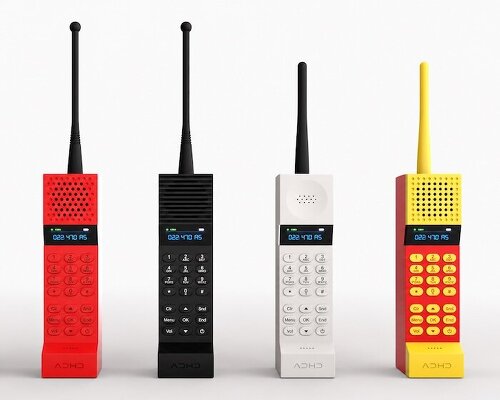
There is something deeply satisfying about watching someone build an entire new device just to avoid using the one they already own. Kevin Noki's ADHD ONE, a 3D-printed brick phone that connects to an iPhone via Bluetooth, is not a product you buy. It is a provocation you assemble. It asks a question that most tech launches are terrified to touch: what if the problem isn't that your phone lacks features, but that it has too many? Noki's answer is a chunky, 19-key handset with an OLED display and an antenna you can swap out for fun. It does one thing. It receives calls. That is the whole point.
We have seen this impulse before. The bracelet that ghosts your notifications without a single screen tried a similar trick, a connected object with no screen, no notifications, no data to refresh. That Belgian studio imagined a wearable that simply knew when to buzz and let you move on. Noki's approach is less subtle and more theatrical. He does not want to fade into your wrist. He wants you to hold a brick the size of a sandwich and press actual buttons. There is a bluntness to it that feels honest. The ADHD ONE does not pretend to be a minimalist lifestyle accessory. It is a deliberate, awkward, plastic-and-wires rejection of the glass slab in your pocket.
Under the hood, it is surprisingly contemporary. A Qualcomm QCC3024 Bluetooth module handles the audio. A Raspberry Pi Pico runs the show. A custom PCB, a rechargeable battery, and a 3D-printed shell that Noki designed in Autodesk Fusion. He released the files for free, STLs, firmware, Gerber files, a bill of materials, so anyone with a printer and some soldering patience can build their own. That open-handedness matters. It turns what could have been a one-off art project into a blueprint for anyone who has ever wanted to lob their smartphone into a drawer and still take a call from their mother. The irony is not lost on us: you have to engage deeply with modern technology (3D printing, firmware flashing, PCB ordering) in order to escape it. But that is also the charm. The ADHD ONE is not a retreat from the digital world. It is a negotiation with it.
The practical takeaway here is sharp and specific: this device does not work unless your iPhone is within Bluetooth range, and it only works for calls from contacts you have manually allowed through Do Not Disturb. That is not a bug. That is the constraint that makes the thing useful. It does not sever your connection to the network, it just forces you to decide who gets through. The question Noki leaves open is whether anyone will actually build it, carry it, and keep using it after the novelty of the retro silhouette wears off. The DIY kit is listed but not yet available. The source code is not included. The files are for personal use only. So for now, the ADHD ONE exists as a brilliant, slightly feral sketch of an idea, waiting to see if anyone wants to hold a brick to their ear badly enough to print one themselves.