
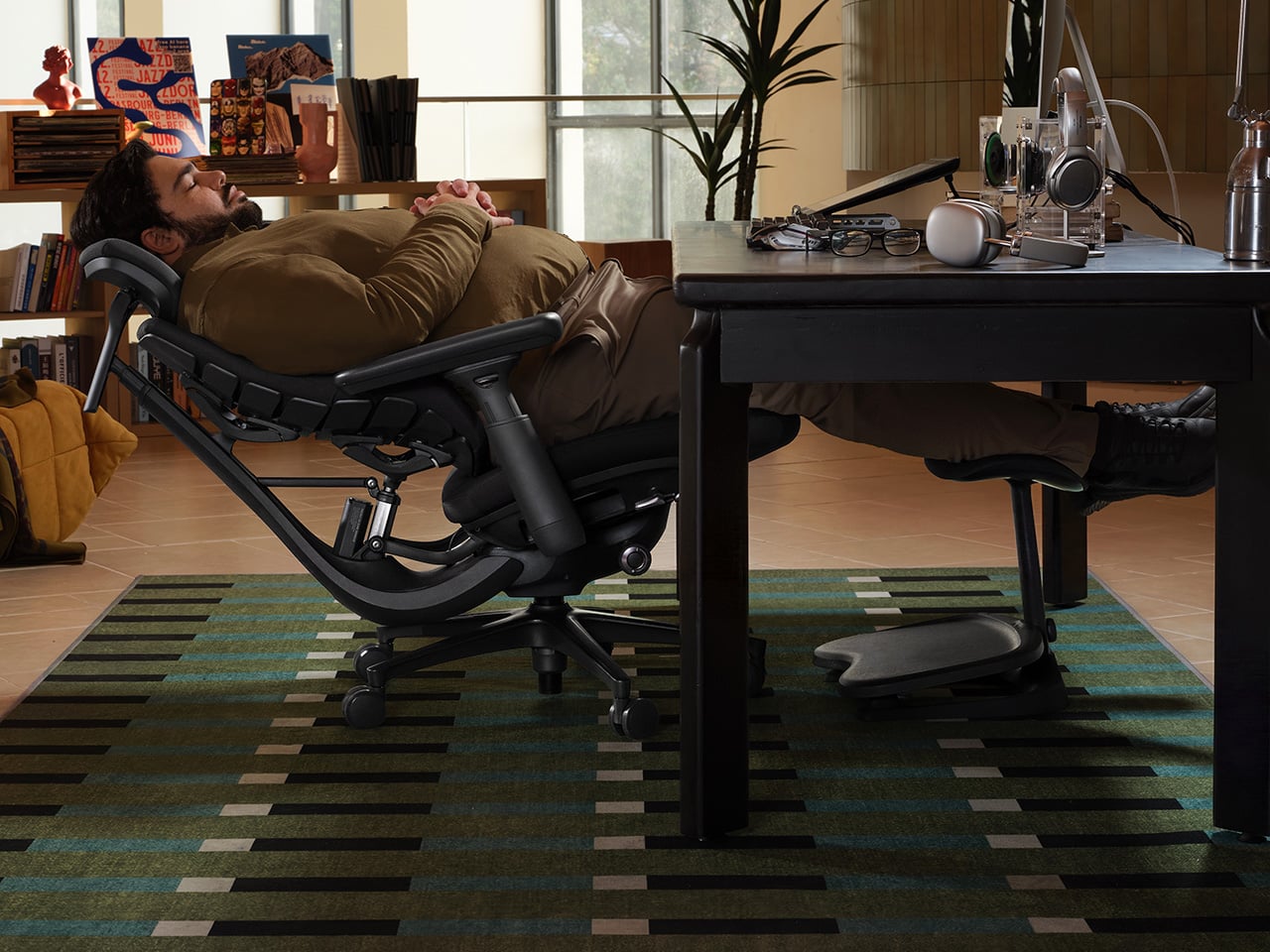
The LiberNovo Maxis Airflow costs $1,119 and it will absolutely, without question, change how you think about sitting down. That is not a small claim, and it is not a small chair, it is explicitly built for people between 5'10" and 6'7", which immediately makes it more interesting than ninety percent of the office seating market that quietly assumes you top out at five-nine. But the real trick here is not the dimensions. It is the six-spring Controlled Recline System that builds resistance progressively as you lean back, and the motorized stretch sequence called OmniStretch that runs for five minutes in deep recline. You are not just buying a bigger chair. You are buying a piece of furniture that admits you shift positions over the course of a day, and then actually follows you through those shifts instead of leaving you to wrench a lever and hope.
This is the same kind of thinking that made us stop and stare at Nextool's new F20 multitool has three handles and a whole lot to prove, a tool that refuses to pretend one grip fits every task. The Maxis Airflow does the same thing for your spine. Its Bionic FlexFit backrest uses eight separate flexible panels that contour independently, its SyncroLink mechanism keeps your back in contact as you move, and the motorized lumbar support adjusts at the push of a button. You are not fighting the chair to find a comfortable position; the chair is fighting to stay comfortable with you. And then there is the fan. A centrifugal fan draws air through a five-layer cushion at two selectable speeds, pauses when you stand up, and resumes when you sit back down. It is the kind of detail that sounds almost silly until you have spent eight hours in a mesh chair that leaves your thighs feeling like they just ran a half-marathon in a wool suit.
The rest of this roundup understands that a desk is not a single surface, it is a negotiation between what you are doing right now and what you were doing an hour ago. The Orbitkey Desk Mat Pro hides yesterday's notes under a top layer so they stay accessible without colonizing your mouse area. The Modhaus Upright gives your phone a charging dock made of cast concrete and solid hardwood, which is frankly more dignified than the black plastic slab currently living on your desk. And the Ugmonk Gather Wood Zigzag Tray lays out your pens in individual walnut grooves, which is the exact opposite of the dark cup where all your nice pencils go to die. Each of these objects does one thing well and then gets out of the way. That is harder than it sounds. Home Depot Has a Gerber Multi-Tool That Costs Less Than a Good Lunch proves you do not need to spend a lot to get something functional, and the same principle applies here, except the chair is the exception, because the chair is where your body lives for half your waking hours.
The Logitech Pebble Up is the sleeper in this group. A mouse that physically lifts its upper section into an angled configuration for desk work and flattens back down for carrying is a mouse that understands your day is not one long typing session. It connects to three devices via Bluetooth or Logi Bolt, and its rechargeable battery means you never have to dig through a drawer for an AA at 3:47 PM on a Tuesday. That is a specific consequence worth watching: the Pebble Up suggests that even the most mundane objects on your desk are starting to admit that you move around. The Maxis Airflow, meanwhile, ships with a six-year warranty on the frame and two years on the electronics, which is either very confident or very necessary for a chair with a battery-powered fan and a motorized stretch sequence. Either way, the question is not whether you need a better chair. The question is whether you have been ignoring the one detail in the spec sheet that actually matters: you are not the same person at 9 AM that you are at 4 PM, and your furniture should know it.